

Welcome to this week’s Four For Friday, four tantalizing morsels of innovation from the past week covering systems innovation, longevity, political transformation and AI.

1. A practice guide to systems investing
TransCap Initiative has published a practice guide for systemic investing - what many are seeing as the next iteration of impact investing. Where standard impact investing may allocate capital to a single company selling say, plant protein, systemic investing tries to flip entire energy systems or food networks.
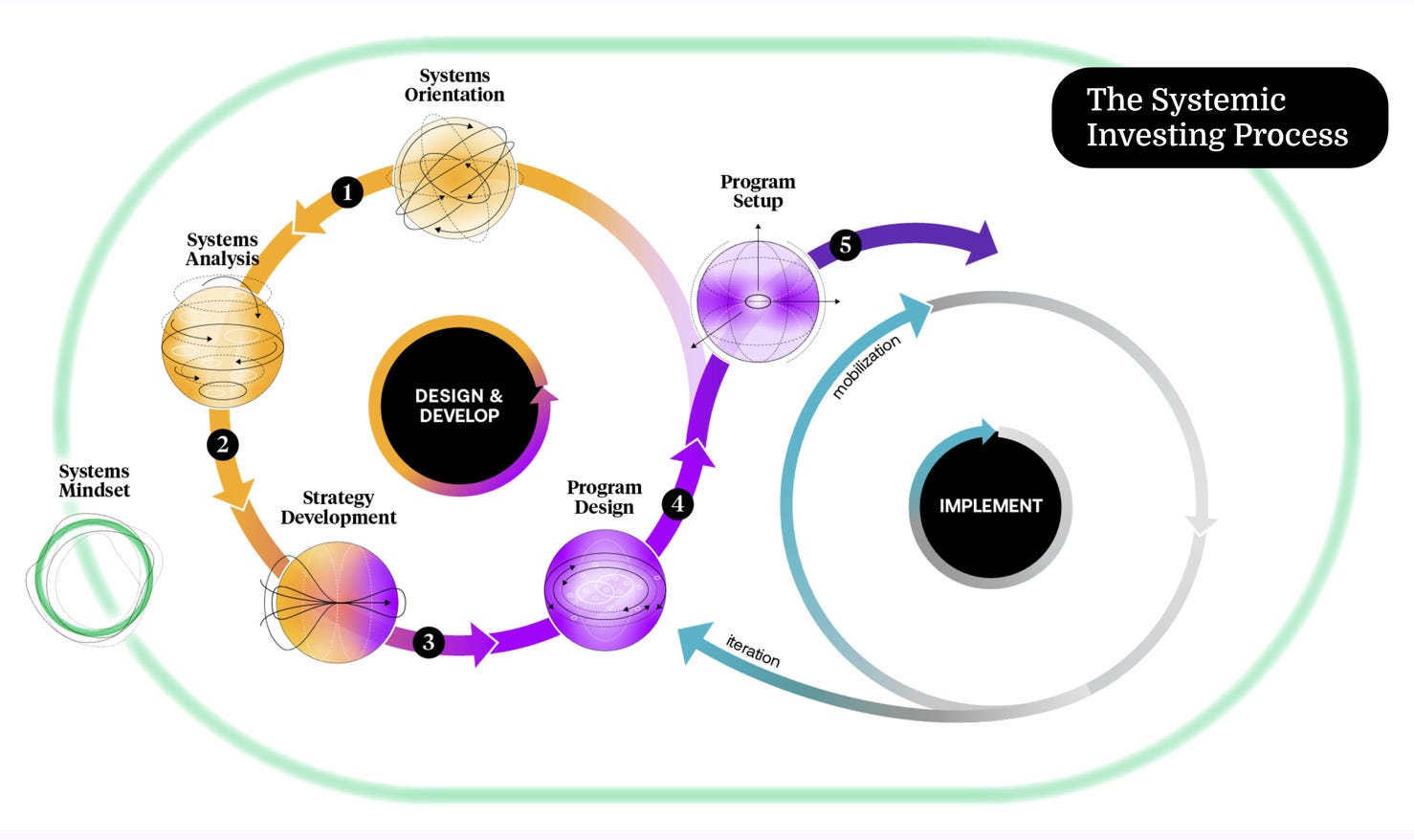
The guide introduces "transformational intent" as its core concept: not a fixed goal but a directional north star, held lightly and revised as complex systems shift.
Practical tools include scenario development, the 2x2 matrix method, and the Three Horizons framework. A good case study is Builders Vision - a holistic approach towards ocean strategy, that connects a north star to four outcome areas across blue economy, policy, and ecosystem health.
The So What: Capital that targets whole systems, not single companies, is the next frontier of impact investing.
2. Genes do matter for healthspan, after all
A study from the Weizmann Institute has found that genes matter about twice as much as previously estimated - accounting for up to 50 percent of the variations in human lifespan.
They analyzed sets of twins, filtered out accidents and infections, and uncovered the major genetic influence on biological aging.
The So What: DNA plays a larger role than previously estimated in determining how long we live.
3. A seismic political shift - from caretakers to combatants
Australian pollster Kos Samaras offers a view of Western democratic politics: the post-1945 consensus culture, built on managed centrism, absorbed interests, and projected calm, is collapsing. Voters are not punishing incumbents for bad policy. They are punishing them for loyalty to the status quo - an economic settlement that has delivered a generation of stagnant wages, asset inflation, and structural lock-out.

The demand is for combatants: leaders who name enemies and fight without apology. This happens on the left as well as the right - Zohran Mamdani’s 2025 New York mayoral win, the UK Greens’ quadrupled parliamentary representation, and Australian Gen Z’s drift from major parties suggest this is not just a right-wing phenomenon. The party that finds an authentic left combatant first, he argues, will own the decade.
The So What: Institutional loyalty to a broken economic settlement is now a political death sentence, everywhere.
4. Cognitive Rot is a thing after all
A study from UCLA, MIT, and Carnegie Mellon is the first to establish a causal link between AI dependency and cognitive erosion.
In experiments, 350 Americans completing fraction equations with GPT-5 assistance, the AI group initially outperformed the control. But when access was cut after just ten minutes, their problem-solving accuracy fell sharply and, crucially, so did their willingness to keep trying.
A separate experiment with 1,200 participants across maths and reading tasks replicated the finding. The researchers invoke the “boiling frog”: each individual act of AI delegation feels costless, but the cumulative effect on what they call "productive struggle" — the very mechanism through which skills are built — could be irreversible by the time it is visible.
One bright spot: participants who used AI for hints rather than answers fared considerably better once the chatbot was removed.
The So What: AI dependency may be as bad - or worse - for cognitive health as social media.
AI Tool of the Week: Polsia - Autonomous companies
For a mere $49 a month and 20% of revenues, Polsia will create and run a company with zero employees.
That’s all for now, happy weekend everyone.
- Stephen