

Welcome to this week’s Four For Friday - delivered from Yoyogi park in Tokyo. Four tantalizing morsels of innovation from the past week covering systems innovation, longevity, political transformation and AI.

1. Systems investing compared to other investing types
One of my most consistent themes in this newsletter is the topic of Systems Investing, and I’ll keep hammering the topic until it becomes everyday language. This article does a nice job in framing it in relation to a lot of other things you may be more familiar with.
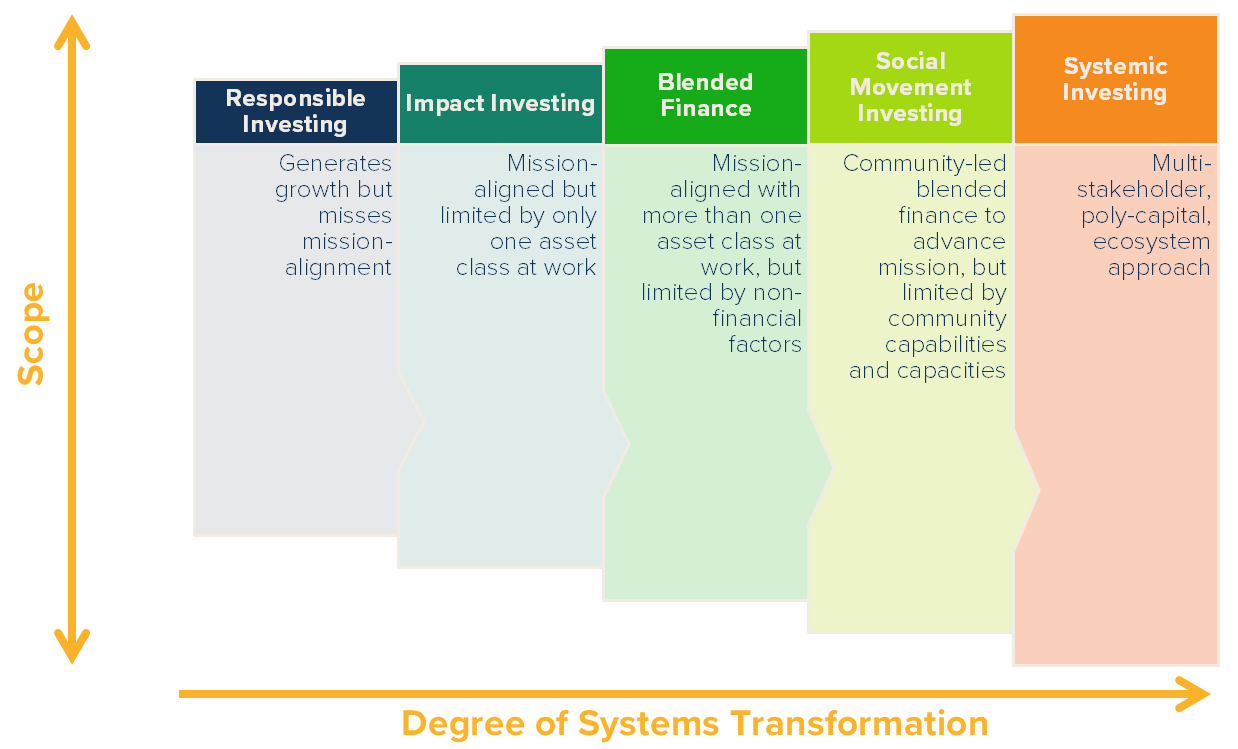
Systemic investing is a multi-stakeholder, poly-capital ecosystem approach.
The framework charts a spectrum from responsible investing through impact, blended finance and social movement investing to systemic investing.
His definition is compact: a multi-stakeholder, poly-capital ecosystem approach. The shift is from single instruments toward deploying financial, social, political, natural, relational, human and narrative capital simultaneously across an ecosystem of connected initiatives. He cites TransCap Initiative, FEST and TWIST as global momentum, with Raven Indigenous Outcomes Fund and the Afro-Caribbean Business Network’s microloan fund in Canada.
The key point he’s making - familiar with LF readers - is that polycrisis problems (housing, climate, mental health, polarisation) cannot be solved by any single instrument or actor working alone.
The So What: Money is one form of capital among many. Systemic change requires deploying all of them with different risk profiles and project types.
2. Philanthropy: asleep at the wheel? A better approach.
This piece in SSIR, argues philanthropy is sleepwalking through the most serious test of civilian protection norms in generations.
Drawing on 25 years across the Pentagon, UN and NGOs, Jenny McAvoy notes the civil society ecosystem has already been built and have a track record, with groups such as the U.S. Dept of Defense's Civilian Harm Mitigation and Response framework, now being adopted in Iraq, Nigeria and the Netherlands.
The problem is funding: fragmented, project-based, concentrated on a few actors, with multi-year flexible grants rare. McAvoy calls for a dedicated collaborative fund modelled on Freedom Fund and Co-Impact, treating civilian protection as a systemic challenge rather than a crisis line item.
The So What: Funding ecosystems, not ad hoc projects, is how philanthropy delivers on its promise.
3. A playbook for philanthropists who want to get AI
Another take on philanthropy’s failings, this time with an AI focus. Mike Kubzansky, departing CEO of Omidyar Network, argues in SSIR that philanthropy is treating AI as peripheral, and it should be core.
AI should be front and center for philanthropists: state legislatures filed over 1,500 AI bills this year, up from 200 three years ago, while trillions in private capital flow toward capability of frontier models rather than good governance.
Kubzansky’s playbook draws on automobile safety history (regulation accelerated adoption, not the other way round) and recent legal wins against Meta and YouTube for addictive design. He points to Omidyar’s Anthropic equity stake alongside Ford and Nathan Cummings Foundations, and the new Humanity.AI coalition of nearly a dozen funders, as templates for the bigger, faster, coalition-based posture the moment demands.
The So What: Philanthropy’s cautious approach feels like an out of date luxury.
4. Vampires in Power: Immortality as an Authoritarian Fantasy
This piece from the NY Times discussed last September’s hot-mic moment when Xi Jinping and Putin, both 72, were caught discussing organ replacement and indefinite life. This is part of a trend of (almost always male) billionaires and political elite deciding that death is optional.
Peter Thiel funds plasma transfusions. Sam Altman has put $180 million into Retro Biosciences. Bezos backs Altos Labs. Saudi Arabia’s Hevolution (not a particularly gender inclusive name…) Foundation runs a $1 billion annual budget bankrolling Diamandis’s $101 million XPrize Healthspan among other things. Singapore-based Immortal Dragons is funding research into “brainless clones” as backup bodies. The article makes the point that radical life extension has become intertwined with the excess concentration of power; longevity as alchemy. Normal rules dont apply, so why would biology?
The So What: Longevity science risks becoming a political tool and cause of societal division if it’s seen as the luxury for dictators and billionaires.
Bonus: Cultural Lodestone of the Week
Rather than just another AI tool (it’s impossible to keep up) I’m going to start reading (I wish I could say re-reading) some literary classics to see how they can inform the frenetic world we’re in. I’m calling this a cultural ‘lodestone’ because these have their own inherent magnetism and north star orientation; two characteristics that I’d aspire to on a good day…
Hermann Hesse’s The Glass Bead Game (1943), the novel that won him the Nobel Prize, imagines a 25th century future, where humanity’s life’s work is the Game: an intricate symbolic language that synthesises music, mathematics, philosophy and art into single meditative sequences, linking a Bach fugue to a mathematical proof to a line of Confucius. The protagonist, Joseph Knecht, rises to become the highest master of the Game, then walks away.

His realisation is that any system of knowledge sealed off from lived experience eventually calcifies.
Not sure I need to make the connection to today’s LLMs any clearer. AI tools can now do by algorithm what Castalia’s monks did by hand. Timothy Leary was on to this in 1986. Hesse’s warning still resonates: surfacing connections is the easy part. Incorporating them into a life is still the work. Hesse wrote the user manual for AI eighty years early. And gave us an exit path.
That’s all for now, happy weekend everyone.
- Stephen