

Welcome to this week’s Four For Friday - topical stories focused on healthspan, systems change and AI for impact. Am back from 2 weeks in Seoul and Tokyo, full of APAC inspiration. Happy reading!

1. How the Walton Wunderkind spends billions on the environment (hint: systems investing)
This is the first press interview that Sam Walton’s grandson, Lukas, has given about how he’s building out his investing approach to improve the planet. His fundamental belief - in line with this newsletter’s - is that business, if directed in the right way, can be a force for good, and help fix many of the problems it created.
He’s spending roughly $15 billion in three areas: ocean conservation, regenerative agriculture and clean energy, and using a systems approach to bring in other investors to the table and fix the infrastructure, not just fund individual shiny projects.

There’s a good case study on the Builders Vision approach put together by TransCap, which I’d recommend to anybody interested in this topic.
The So What: This shift to talking in public by Lukas is a welcome vote of confidence in the idea that those with capital have an obligation to fix planetary problems, not just accumulate more capital. Let’s hope some of the other 9,000 family offices heed that call.
2. A new framework for healthy, sustainable homes: Passive House
At tonight’s two-year and birthday party for my longevity club, Saint Haven, I heard about the concept of Passive House from Tabitha Robb, who runs a boutique Melbourne-based buyer’s advocate firm, Prop Culture.
The concept, which was born out of Germany 35 years ago, is about designing - or retrofitting - a house to be maximally energy efficient, and that in turn has multiple related benefits. From the website:
Passive House stands for confort, health, sustainability of our buildings. (These) buildings make efficient use of passive heating and cooling sources, and the standard can be applied to all kinds of building typologies. This means they are heated mainly from the sun and from heat emitted by people and appliances.
The key features include: Super-insulation, thermal ‘bridge-free’ design (heat can’t bypass the insulation layer), airtight construction, high-performance windows (triple glazing) and heat recovery ventilation (mechanical ventilation constantly supplies filtered fresh air while recovering heat from outgoing stale air). It’s no surprise I hadn’t heard of it in Australia - there are only 88 certified buildings in this country out of a total of 80,000 globally.
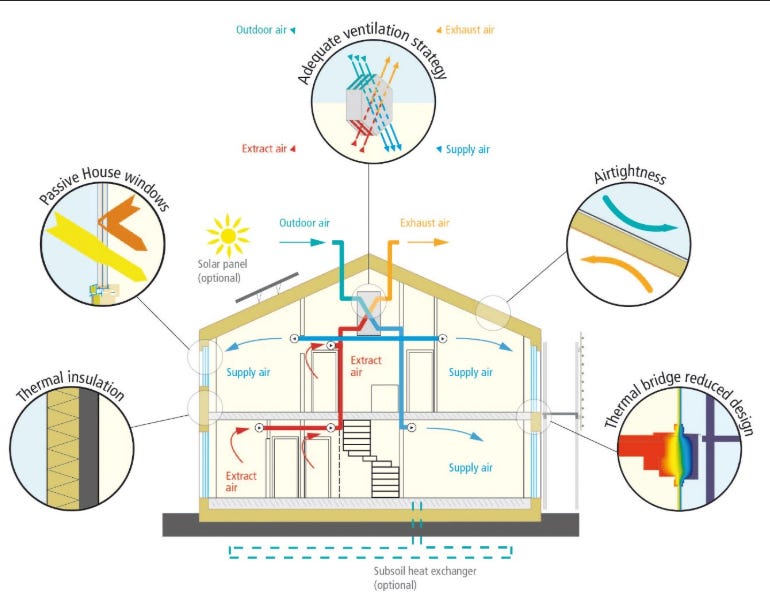
This article outlines some of the health benefits from the UK perspective. The NHS spends an estimated £1.4 billion a year on illness linked to cold or damp homes, and a 2022/23 parliamentary inquiry attributed almost 5,000 winter deaths across England, Scotland and Wales to cold housing. Damp accounts for 7% to 14% of childhood asthma and raises depression risk by 60%. Meanwhile the share of UK homes reporting summer overheating has quadrupled to 80% in a decade. Passive House holds 20-21°C, filters air continuously, cuts external noise by half, and stays habitable for a week without heating at minus 13°C outside.
The So What: Buildings are the longest-duration health intervention we own, and we still regulate them as energy assets.
3. A longevity metric that matters: Intrinsic Capacity
The WHO defined intrinsic capacity in 2015 as a composite of five subdomains: cognition, locomotion, sensory capacity, psychological wellbeing and vitality. Most of the tests already exist, including grip strength and walking speed. Its value is not the single score but the trajectory, since decline is detectable before disease appears. That makes it a plausible proxy for ageing, which matters because lifespan trials would take decades and the FDA still refuses to classify ageing as a disease. The WHO hedged in 2022 by adding “aging associated decline in intrinsic capacity” to ICD-11. ARPA-H is now funding work to validate it, with real-world studies running in France and New Mexico.
The So What: No approved longevity drug arrives until regulators agree on what improvement actually looks like.
4. Screenless wearables take another run at agetech
Two launches this week caught my eye, both screenless, both aimed at ageing in place: Luffu and Carely. Form factor has been the unresolved argument in age tech for a decade. The category is a graveyard of clunky devices with poor battery life that telegraphed “I’m old and frail” (the spectre of Life Call still haunts it). These are not that. Luffu comes from the Fitbit founders and is built around the whole family rather than the older adult alone. Carely has yet to launch but is clearly designing for form as well as function.
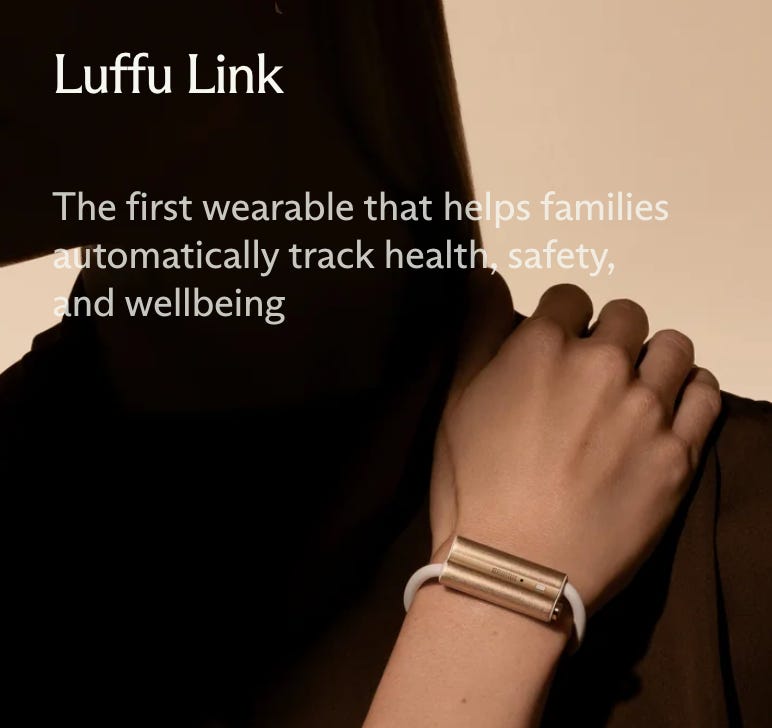
The harder question is what each approach is actually good for. Wearables do biometrics: sleep, activity, heart rate. Ambient sensing does movement patterns and falls, and nobody has to remember to charge it. Expect specialisation by use case rather than one winning device.
I take two rules away for age tech builders: the best form factor is the one you forget you are wearing, or never wear at all; and we should design for the ecosystem from day one, because the hardware will date faster than a platform.
The So What: Devices are disposable. The system they connect to is the product.
AI parody video of the week:
Bunker Boyz fits a lot of spicy takes and inside-baseball tech gossip into a few minutes, skewering our (male) AI overlords, suggesting, inconceivably, that they’re more interested in themselves than in the future of humanity.
That’s all for now, happy weekend, everyone.
- Stephen