

Welcome to this week’s Four For Friday - topical stories focused on healthspan, systems change and AI for impact. Enjoy!

1. The healthspan gap is driven by a health data gap
A big and welcome shift in discussions of ageing has been a shift from lifespan, how long people live, to healthspan, how much of those years are in good health. This new paper by AgeTech X and OpenHealth Technologies argues that the biggest obstacle is not a lack of biomarkers, but fragmented health data.
Blood tests collected over decades sit in incompatible systems, making it difficult to track the biological changes that matter most. The answer is harmonisation, not simply standardisation. By turning scattered records into a coherent, lifelong health timeline, the paper argues, prevention becomes measurable, personalised and scalable.
The So What: Longevity’s missing breakthrough may be infrastructure rather than medicine.
2. GLP-1s - ageing into the unknown
America’s GLP-1 boom is becoming a vast, uncontrolled experiment in ageing. 1 in 9 US adults - around 30m - are currently on these weight loss drugs, and while the hope is that shrinking waistlines translates into longer, healthier lives, the evidence is less certain.
The Scientific American piece notes that clinical trials have largely excluded seniors, leaving unanswered questions about frailty, muscle loss, dehydration and interactions with other medicines. For robust older adults, GLP-1s may reduce disease risk; for frail patients, the trade-offs may be severe.
The So What: The real measure of GLP-1 success is not weight lost, but function preserved - how to preserve muscle and mobility while taking these drugs is an open question.
3. Oxygen levels - a new planetary boundary?
Oceans are running out of breath. A new review by scientists at UC San Diego’s Scripps Institution of Oceanography argues that declining oxygen levels in oceans, lakes and rivers have become a global threat serious enough to be a new “planetary boundary”.
Driven by rising temperatures, nutrient pollution and disrupted ocean circulation, aquatic deoxygenation is reshaping ecosystems, weakening food webs and undermining natural climate-regulation.
The researchers argue that oxygen loss should no longer be treated as a standalone environmental issue, but as part of a wider web of pressures pushing Earth beyond safe limits.
The So What: A reminder that planetary health is governed by invisible variables. What cannot be measured is often what gets ignored.
4. The best video on AI you’ll watch this week
Garry Tan, Y Combinator’s President & CEO comes across - in other videos I’ve seen - as a rather self-effacing, almost diffident, leader of arguably the most powerful tech organization on the planet. Google and Anthropic are trillion dollar companies today, but Y Combinator has equity in over 5000 companies it’s helped launch from Airbnb to Stripe, and an fearsome network of people thinking hard about where tech is taking us. This video of Garry discussing the need for all of us to “own our tools” was the most energetic and passion I’ve seen him; he’s clearly got the bit between his teeth.
And what a bit it is; he’s advocating for all of us to build our own brains to become 10x, 100x more productive, and wants employees to keep their skills, not give them way to their employer. So it’s actually very much inline - perhaps with a more positive twist - with my Road to Serfdom post from a few weeks back. Worth a watch.
The So What: When the Kevin Bacon of tech says this is where the future is going, it’s worth spending some time building your own AGI and trying it for yourself.
AI tool (for the resistance) of the week: ShieldFont
This rather intriguing tool - Shield Font - is for my more suberversive readers. And to be honest I’m not sure it’s a good idea, but it’s certainly novel.
As Pascal Finette put it, “the resistance has a typeface now”. The font looks perfectly normal to human readers, but the underlying code that the AI agents read mixes up words in subtle ways, that render the text have has been scraped confusing or pointless. A poisoned pen of a sort.
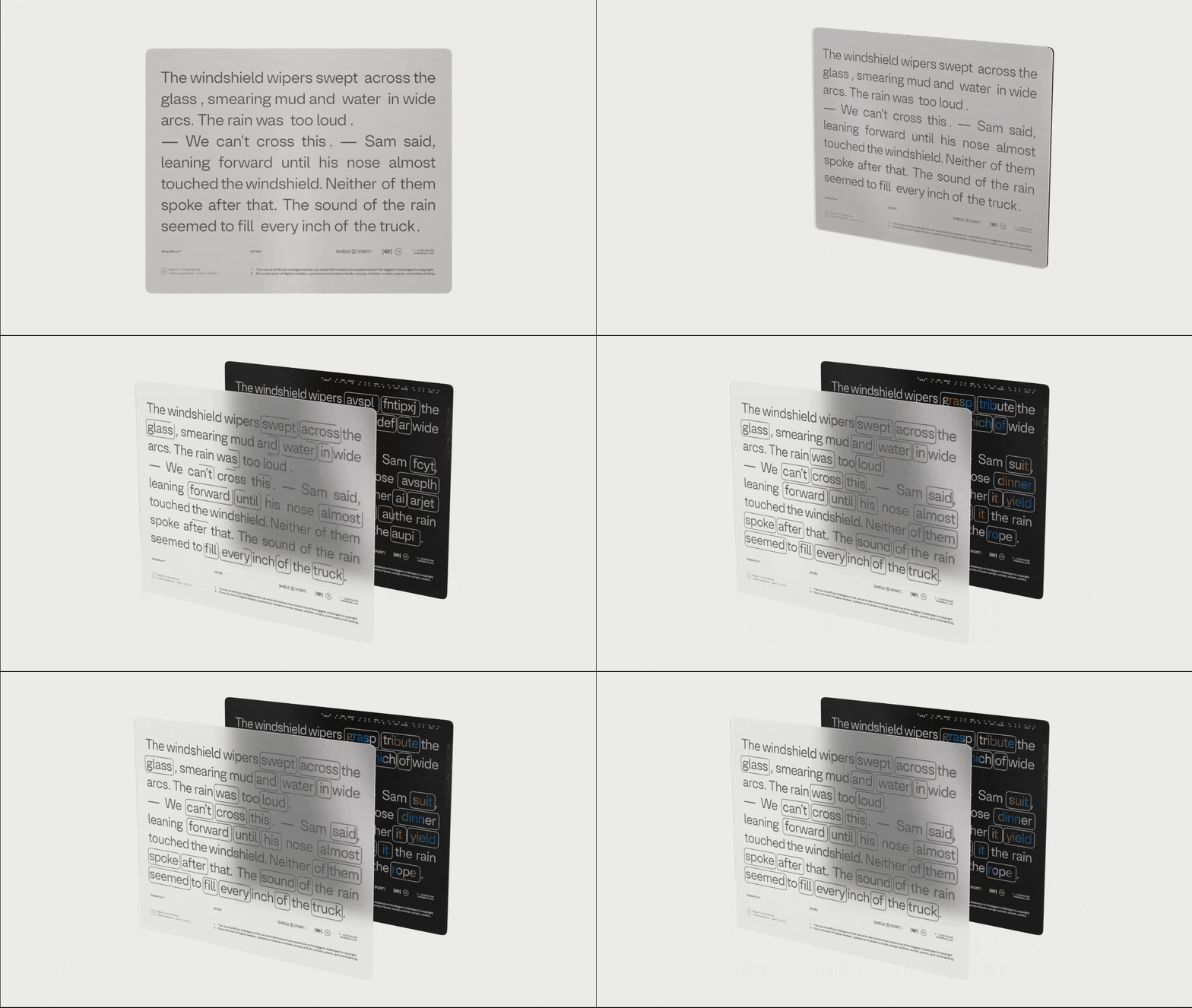
"ShieldFont is not an anti-AI project," S&A's founders Isaque Seneda and Gabriel Abrucio stress. "We’re simply against the idea that publishing is the same as consenting. We saw how existing opt-out protocols such as robots.txt were being routinely bypassed, so we wanted to create one that could enforce itself. The answer was to turn the content itself into the opt-out."
Whether it will protect writers, or just add a layer of tax - to be inevitably born by consumers - is an open point, but a fascinating solution that goes to show the AI resistance is real, tech-savvy, and inventive.
That’s all for now, happy weekend, everyone.
- Stephen