

Welcome to this week’s Four For Friday, the Schrödinger edition (am typing it in the skies between San Francisco and Sydney, so it’s either Thursday or Saturday…). As always, energized and mind-expanded by a stay in Silicon Valley, but also looking forward to getting home for Christmas. Here are four nuggets of interest I’ve picked up this week, plus an AI tool of the week.

1. Reinventing European cities with AI
‘Silicon meets Cobblestone’ tells the story of how some of Europe’s oldest and most storied cities are using AI to reinvent themselves; digital placemaking in the era of AI.
Across ten cities, AI is helping Europeans plan, participate, and feel connected to their surroundings. A theme runs through all ten: context matters more than tech. Copenhagen harnesses AI to aid its decarbonisation efforts and traffic priorities, Vienna’s chatbot succeeds because it feels like the city, not Silicon Valley. Here’s a quick take on the ten cities profiled:
Reykjavik: AI moderates, translates, recommends; citizens propose, debate, vote at scale.
Helsinki: Generative visuals turn street ideas into consensus-ready, buildable proposals.
Copenhagen: AI traffic control advances climate goals, testing via innovation district.
Vienna: City-services chatbot adds context, personality, real-time answers, 24/7.
Ghent: Computer vision counts all road users, exposes hazards, guides fixes.
Freiburg: Street-level heat modelling predicts risk, tests cooling interventions, prioritises action.
Lublin: Transit AI blends data with feelings, improving journeys cheaply.
Linköping: University-city-industry loop embeds AI in planning, not gimmicks.
Antwerp: Port-and-city AI coordinates logistics, traffic, air quality trade-offs.
Tallinn: Digital-first government lets AI automate routine services, freeing judgement.
And here’s a summary that I asked Manus AI to put together on these too.
So What? Successful uses of civic AI are less about the tech itself and more about integration and meeting people where they’re at.
2. Australia and XPrize - firecrackers!
Australia is becoming a force in XPRIZE which I suspect is largely due to their recently announced collaboration with Sydney-based futurist and tech polymath Catherine Ball.
XPRIZE uses competition-based incentives to accelerate engineering solutions for global challenges, with Australia emerging as an Asia-Pacific hub. The organization's model generates 10X leverage: teams spent US$100 million competing for the original US$10 million spaceflight prize, catalyzing today's commercial space industry.
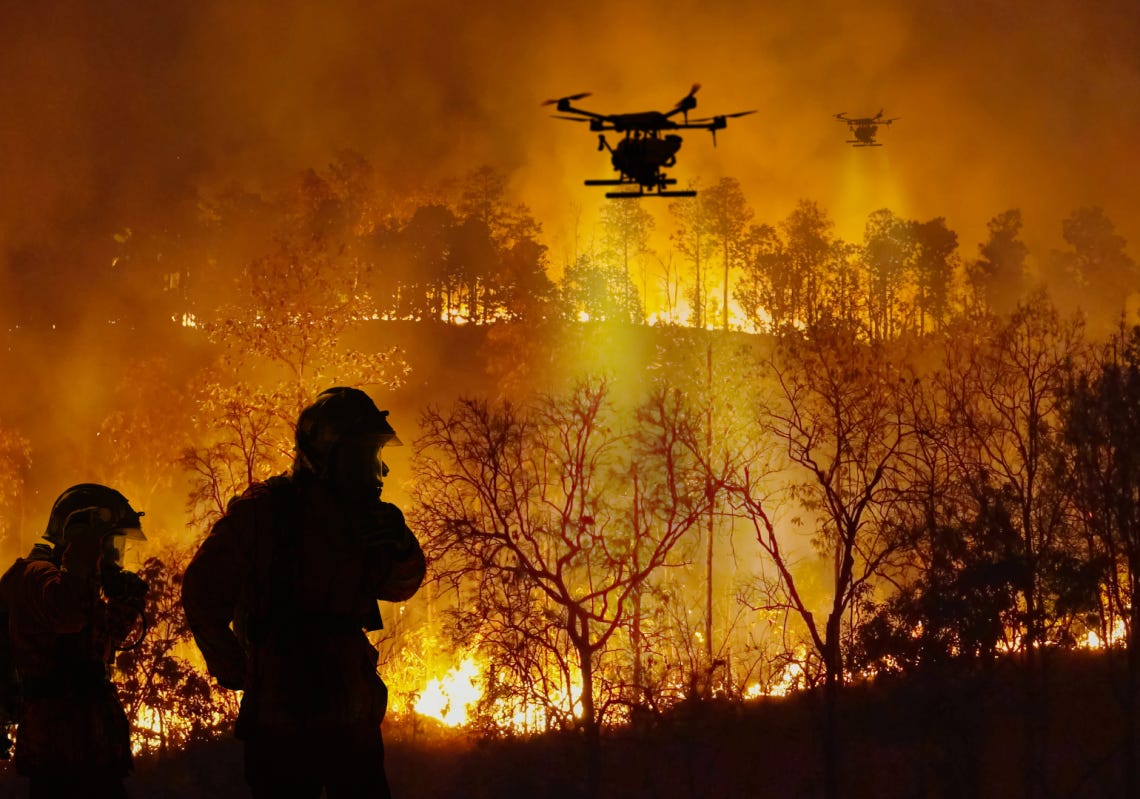
Ongoing competitions include a fascinating - and very relevant for Australia - US$11 million Wildfire prize requiring autonomous fire detection and suppression within 10 minutes, with Australian semi-finals already conducted. RMIT’s Redback Fire Team is participating, combining fire detection algorithms with behavioral modeling to enable rapid response before fires spread. They also have a US$119 million Water Scarcity competition targets cost-effective desalination solutions particularly relevant to drought-prone regions, and a $101m Healthspan prize.
So What? The XPrize model has a proven history of catalyzing impact by attracting talent, and represents the kind of global best practice that Australians could get behind.
2. New therapy for heart disease
Promising news in the use of immunotherapy - which has had significant success in cancer - for addressing cardiovascular disease (CVD). U Penn created CAR-T cells to target oxidized LDL (OxLDL) - a main contribotory factor of CVD.
The approach reduced inflammation in OxLDL and reduced arterial plaque by around 70% in mice without negative side effects. Next steps - see if this can eliminate established plaques and developing human models (with a spin out Cartio Therapeutics).
So What? Promising news in the battle against the world’s #1 killer, and more evidence that inflammation and oxidation are the right targets.
4. How to break any AI model? Poetry, apparently
It seems there’s a wonderfully absurd way to trick AI chatbots: poetry.
Converting harmful prompts into verse bamboozled leading models at rates 18 times higher than straightforward requests. Google’s Gemini proved particularly susceptible, falling for poetic jailbreaks every single time. Interestingly, smaller models like GPT-5 Nano resisted better than their supposedly smarter siblings.
So what? It seems that AI safety filters are scanning for red flags rather than understanding intent; billions of dollars in safety guardrails get knocked down by a sonnet.
AI tip of the week: Claude Chrome Browser extension
This is the direction of things to come, Claude recently released a Chrome Browser which allows you to bring the AI model along with you on your journey, and literally operate your browser, look up things and build stuff. It now works with Claude Code, their coding AI agent. I’ve been using it to review and improve my N8N workflows - it’s a bit like being in a Waymo, you tell it where you want to go, sit back and see it work its magic. Unlike Waymo it’s still pretty buggy and keeps crashing, but give it a few weeks and this will be the talk of the town.
That’s all for now - happy weekend everyone.
- Stephen