

Welcome to this week’s Four For Friday. Here are four nuggets of interest I’ve picked up this week, plus an AI tip of the week.

1. How to win when the AI bubble pops
Cory Doctorow is one of the most trenchant, readable and insightful commentators about tech and its impact on business, society and our common morality. His latest Guardian piece dissects what’s going on with AI, and the pending bubble in refreshing clarity.
Seven AI companies now comprise over a third of the US stock market, endlessly circulating the same $100bn as IOUs. The pitch to investors is not about empowering workers but delivering efficiencies: fire nine-tenths of America’s 32,000 radiologists, pocket half the savings, remit the rest to AI vendors. What we get “reverse centaurs” - humans reduced to ‘accountability sinks’ who sign off on AI diagnoses at breakneck speed while absorbing blame for algorithmic, blackbox failures.
So first tip - don’t be that human that holds the blame for the AI overlord - that starts with seeing where the value is shifting in your industry and not being squeezed in the middle (perhaps easier said than done, tbh).
However, the upside to all this - when this bubble bursts (and it will), the wreckage could yield cheap GPUs for climate modelling, open-source transcription tools, and a raft of programmers skilled in applied statistics. Unlike the monkey JPEGs that crypto gives us, an AI correction should be productive.
The So What: AI’s collapse will leave useful technical infrastructure, unlike purely speculative bubbles.
2. Does your home heal or harm?
Dr Gautam Gulati is one of the most articulate advocates of what some are calling ‘home as medicine’ (thanks for the intro, Zayna!), and this post describes the ways in which your home can be a force for health, or not.
We’re now used to the idea that your post code is one of the most important determinants of your health, but what if it’s more micro than that? The real health predictor might be sitting under your roof. The Well Home has coined “Home Determinants of Health” (HDoH), a 12-factor framework measuring how indoor environments shape wellbeing.
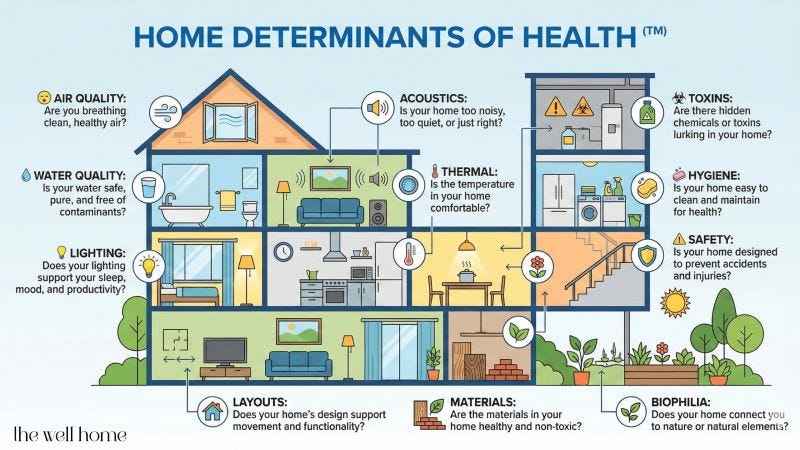
Think air quality (directly affecting respiratory outcomes), circadian-friendly lighting (proven to reduce depression by up to 30%), and biophilic design (linked to faster recovery times). While real estate obsesses over planetary sustainability, this lot focuses on human biology. The pitch is simple: homes should serve both Earth and occupants. Whether this becomes the next LEED certification or remains luxury marketing depends on whether developers can stomach the premium.
So What? There’s a lot of new attention - and crucially new data signals - around home based health. Look for more about the bedroom, and also the bathroom.
3. GLP-1s are breaking life insurance
A fascinating insight on the cat-and-mouse game between people and the algorithms and actuaries that control their financial futures - life insurance companies.
They face a multi-billion dollar conundrum: GLP-1 meds can temporarily transform high-risk patients into statistical unicorns. Underwriters approve policies based on artificially flattering metrics (BMI, blood pressure, cholesterol), only to discover 65% of users quit within a year, reverting to baseline risk by year three. The result? “Mortality slippage” (i.e. oops, we got our predictions about death payouts wrong) has nearly tripled since 2019, reaching 15.3%; one in six policies is catastrophically mispriced.
Their response - asking harder questions (has your weight changed by 10kg or more in the past year?) and also hunting aggressively for retention partners who can sustain adherence (this is a good thing). That should create a host of business opportunities for innovators. The fix isn’t necessarily complicated wraparound care. Statins proved the winning formula: shift from monthly to quarterly refills, strip out friction, add behavioural nudges. Simple beats sophisticated.
So What? GLP-1 adherence solutions become insurance industry necessities, creating massive B2B2C opportunities.
4. Cities as a response to the polycrisis
Regen Melbourne’s CEO Kaj Löfgren discusses how cities can engage and help address the ‘polycrisis’: 88% of WEF experts forecast catastrophic events within two years, yet business carries on regardless. Why?
Logically, it’s because our society has been captured by the market. Commons vanish (can you imagine creating a library or a fire service today?) and household labour is undervalued.
Melbourne’s response to this Regen Melboure, which is ‘social infrastructure’ that gathers 200 partner organizations, using Doughnut Economics to measure thriving beyond GDP. The methodology (Sensemaking, Organising, Insights, Leverage points) tackles missions like making the Yarra river swimmable. As systems thinker Nate Hagens warns, we’ve flown too close to the sun and our institutions are melting. Regen Melbourne is one promising response.
The So What: Cities need collaborative infrastructure to navigate polycrisis, not just traditional government responses.
AI Tip of the Week: Voice AI Hub
Here’s a resource for anyone else looking to get up to speed and build in voice AI - an area that I predict is going to explode in 2026. To me, voice is fast becoming the next interface after mobile, and includes a whole host of benefits (faster, contains biomarker info, more natural, no fat fingers, can be emotionally powerful). I’ve been frustrated with IVRs for years, but now interacting with some of the new voice AI agents is scarily spookily good. I prefer Waymo over Uber, and pretty soon I expect (weirdly) I’ll prefer a voice agent over a human call center operator.
That’s all for now - happy weekend everyone.
- Stephen
Thanks for writing this, it clarifies a lot, particularly the nuanced take on the current AI valutions and the 'reverse centaur' problem, which feels incredibly prescient. It reminds me of how in Pilates, even when you push limits, it's about building core strength for suistanable movement, not just quick, unstable gains, a useful metaphor for building technology.