
Welcome to this week’s Four For Friday, and I trust you made good use of your extra 10 minutes last week as I was away in Queensland with the family. Back to our regularly scheduled programme - four topical stories focused on healthspan, systems change and AI for impact. Enjoy!

1. Building the Longevity Economy will take systems, not pilots
Here’s a piece I wrote with Anne Montgomery and a couple of others for Generations Journal, from the American Society on Aging. In short, ageing populations aren’t necessarily a fiscal threat, but to make them an opportunity we need to think systemically. AARP puts the over-50 contribution to GDP as $45 trillion in 2020 (fully a third of the total).
Nearly 20% of 65+ Americans were working in 2023, 62% of them full-time, double the 1987 rate. Since 2023, the world has had more people over 50 than children under 15, and the child population will not grow before 2040.
We propose a structural fix: research, collaboration and investment. First, responsible AI and shared data infrastructure. Second, rapid testbeds and smart-home microlabs feeding evidence-based scale-ups. And third, field-building to shift policy, capital and narrative together. Project-based funding alone won’t cut it.
The So What: A fair and equitable longevity economy will be built via ecosystem orchestration, not just piloting new tech.
2. Young stem cells reboot the immune systems of mice
A new piece in Nature shows that transplanted blood stem cells from young mice into old ones restored both blood production and immune function. The trick was doing it gently.

Instead of chemotherapy or radiation, the team used an antibody that targets defective stem cells specifically, then flushed the old cells into the bloodstream while injecting fresh ones. The young cells won the race back to the bone marrow.
The old mice regained production of naïve B and T cells, the frontline responders that fade with age. The lead author is blunt about the timeline: clinical use remains distant. His speculative version is banking your own cells in your twenties and redeploying them in your fifties, replacing a blood system the way you replace a hip.
The So What: Longevity’s next frontier may be logistics, not biology: bank young, redeploy later.
3. Casana launches - a wearable that you sit on
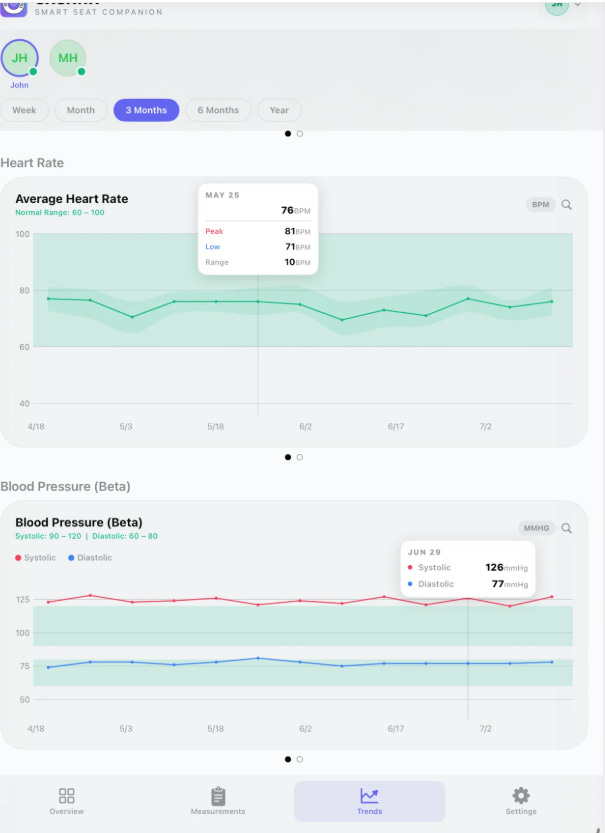
Casana has raised $46 million to launch a $199 sensor-embedded toilet seat, and is betting that “sittables” beat wearables on the metric that matters: adherence. The seat swaps in like any replacement, identifies each user automatically via AI bio-ID, and reads blood pressure, heart rate, blood oxygen and respiratory rate through PPG, ECG and ballistocardiogram sensors.
The target market is deliberately unfashionable. Over 48% of US adults have high blood pressure, yet cuffs go uncharged and unused, and most people over 65 will not wrestle with a device that needs installing, wearing and calibrating. Whoop and Oura, valued at $10 billion and $11 billion, proved the appetite. Casana is chasing the people they miss.
Interestingly, and not obvious from most coverage (I spoke to the founder a few months ago), they’ve only been cleared by the FDA for heart rate and blood oxygen, not blood pressure. So the marketing says ‘blood pressure trends’ as a wellness device, but the device itself shows BP readings, with a (Beta) next to it…
The So What: The best health tech is the kind nobody remembers using.
4. Microplastics associated with 4x heart risk
A study in the New England Journal of Medicine (note from 2024, but still relevant), examined artery plaques surgically removed from 257 adults, and found plastic fragments in 150 of them, visible under the microscope as jagged particles.
Those patients were more than four times as likely to die or suffer a heart attack or stroke as patients whose plaques were plastic-free. The plastic-laden plaques also carried high levels of inflammatory molecules, hinting at a mechanism.
The authors note this is association, not causation, and diet or air pollution could be doing the work (so it could be diet not debris, maybe both). This is a signal that a material we have been swallowing, drinking and breathing for decades may be lodging somewhere it matters.
The So What: We stopped asking where plastic goes: it turns out the answer is us.
AI tool of the week: Flux 3
Since OpenAI pulled Sora, there hasn’t been a great go-to model for simple video creation - this new model Flux 3 however seems to have potential. Check out the video that Ethan Mollick created based on a colourfully inventive prompt:

That’s all for now, happy weekend, everyone.
- Stephen