

Welcome to this week’s Four For Friday. Just landed back in Australia after two intense but productive weeks in Japan and South Korea (hence this being late to press). Watch this space for more insights and updates about a new ‘bathroom health OS’ we’re launching (looking for founding partners), the Chorus Project (looking for evidence & data) and new cross-border innovation networks.

1. World models, or why a squirrel is smarter than Claude
Language models can write sonnets, but struggle to fold a towel. Squirrels fly through the air with tremendous precision, but don’t speak a word. This piece by a Khosla Ventures partner (tip: open in incognito mode if you hit a paywall) argues that the binding constraint on truly capable AI is not compute or clever architecture, but a specific, scarce data type: action-conditioned records of human decision-making, frame-aligned with real-world consequences.
Google’s Project Genie is getting at the solution, collapsing months of hand-coded simulation into seconds. Games may be the wedge to the real world training data, where millions of hours of human judgment and feedback loops is already digitised. The prize is enormous - think Claude Skills but for the real world: a top surgeon can be scaled to rural areas; an electrician’s lifetime expertise deployed across a thousand cities simultaneously. The digital revolution made information cheap. World models promise to make physical capability equally abundant. (Thanks @Malav for the tip!).
That article complements Anthropic’s latest report, which includes visual representations of where Claude is already in use (red), where it could theoretically go (blue) and by extension, where physical AI would still dominate (everything else).
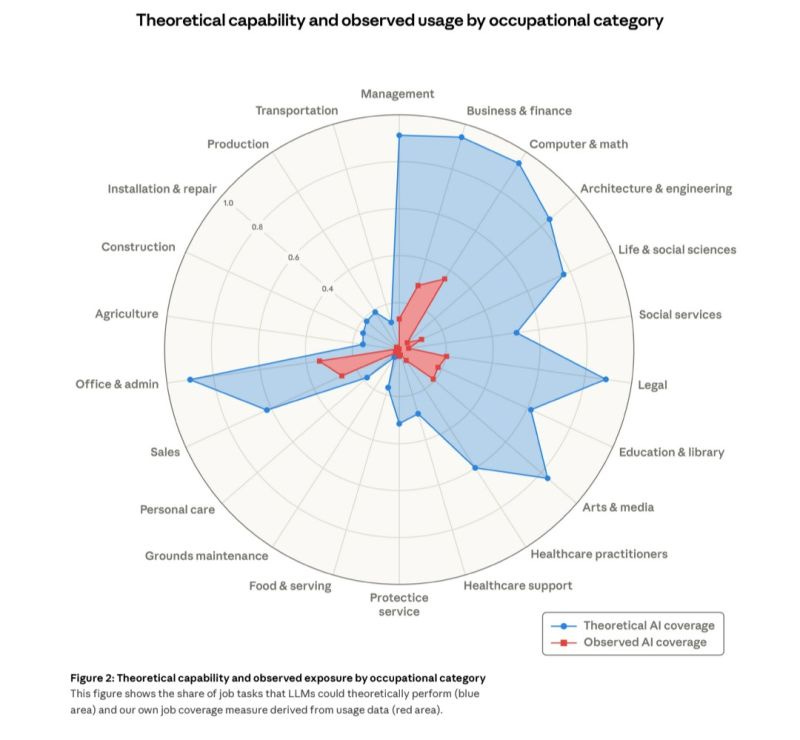
The So What? When we shift from words to reality, the potential scope of AI’s impact goes up markedly, but we’ll need new to find new sources of high quality data showing input —> output feedback loops.
2. Buck Institute aims for federated healthspan knowledge
People are living longer but, as any gerontologist will note, not necessarily better. The Buck Institute has launched Healthspan Horizons, which is positioned as a federated research platform linking real-world longitudinal data from wearables, sleep, nutrition, and labs with deep biological discovery science.
The architecture is deliberately decentralised: approved analyses run across partner environments without requiring centralised ownership of individuals’ health data. The core insight is compounding value: dense longitudinal datasets become exponentially more informative when multiple signals are tracked on the same person over time, enabling earlier detection of decline before a life-debilitating disease takes hold.
Led by longevity ninja Nathan Price and Yi Sherry Zhang, the initiative invites researchers, clinicians, payers, and individuals to participate as co-builders of a healthspan commons, rather than passive data donors.
The So What? Federated infrastructure has long been a holy grail in this space, as it preserves privacy while delivering shared insights. Applying it to longitudinal signals could be a boost to healthspan innovators (myself included) looking for data-driven decision making.
3. Britain’s Water Scandal: Privatisation’s Broken Promise
My home country England is unique in many respects, but one way that’s not a cause for celebration is it’s the only country (besides Chile) where water is privately owned for profit.
The results are damning. In the 27 years since eight-year-old Heather Preen died after paddling in sewage-contaminated water, the industry has accumulated £73bn in debt while paying out £88.4bn in dividends.
English water companies have racked up nearly 1,200 criminal convictions for pollution, yet not one chief executive has faced charges. Thames Water, serving 16 million customers, now operates under a consortium of hedge funds demanding a 15-year exemption from environmental compliance. (When I was living in West London every year or two the roads would be flooded by a broken water main - this isn’t the flood risk we should be prepping for…)
Meanwhile, Paris’s 100% municipally-owned water system achieves 90-96% customer satisfaction (they even have free sparkling water at public fountains). The government’s reform plan, rejecting public control, is dismissed by campaigners as shackling bill-payers to a broken model indefinitely.
The So What? When everyone else does it better, maybe see what they’re doing. Having the regulators funded by the regulated, and loading up debt to pay dividends, means outsourcing externalities to the public and giving capitalism a bad name.
4. AI for events
The International Congress and Convention Association (ICCA) has announced a landmark initiative to develop the first-ever “Global Impact Measurement Tool for Association Conferences”.
This is a group with an impressive member roster - founded with convention bureaus in Barcelona, Copenhagen, Flanders, Sydney, and Tokyo, the project will create a standardized, academically grounded framework to quantify the social, scientific, and economic value that association meetings generate — beyond just ‘more tourists’.
The initiative responds to a long-standing gap: governments and policymakers require concrete evidence of societal value to justify investment in conference infrastructure, yet the broader contributions of these events to knowledge economies and community wellbeing remain a black box.
The So What? An interesting initiative that’s going to need some level of agreement about what impact is and a cross-industry taxonomy, so combining convention centers with an academic network makes sense. However, they don’t expect results in 2028 —> innovator opportunity to get something to market before.
Cool Tool of the Week: SentiVue
Saw this launch on one of the voice AI communities I’m part of and tried it out in Tokyo this week - to do real time translation for events. It worked well. Feel free to mention Looking Forward as a reference, if asked.
That’s all for now - happy weekend everyone.
- Stephen