
Welcome to this week’s Four For Friday. Four topical stories on systems change, healthspan and AI for impact. Enjoy!

1. The impossible maths of the AI boom
According to a bracing article in the FT (gift link here), the arithmetic of the AI boom does not work. Hyperscaler capex is set to grow 20% a year through 2030; revenue, just 15.
To earn 10% on data-centre spend, Microsoft, Alphabet, Amazon, Meta and Oracle would need an additional $2–$5 trillion in annual revenue, against a current base of $1.5 trillion.
Meta has spent $230 billion to book $3 billion.
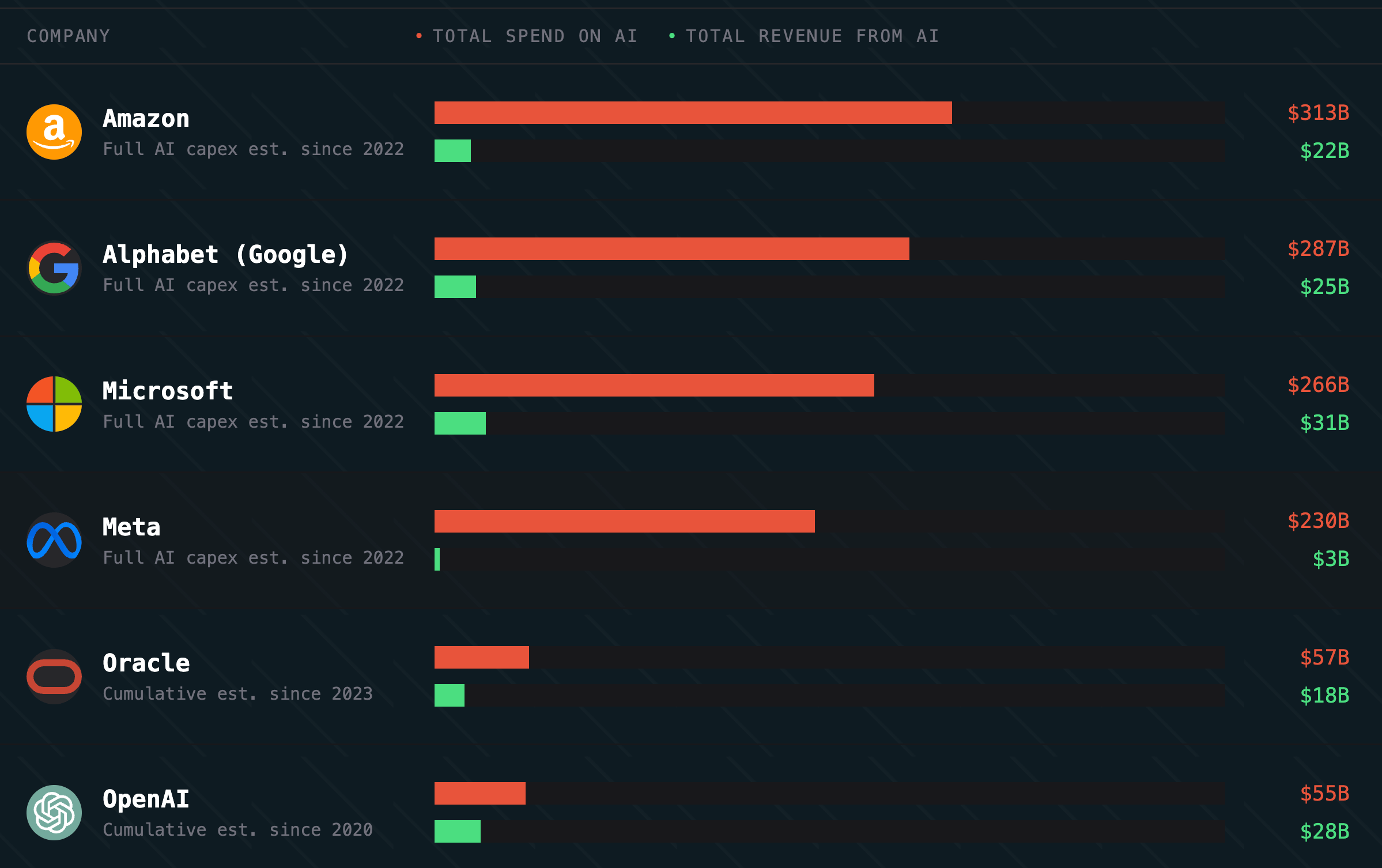
OpenAI and Anthropic burn $1.69 for every $1 of revenue, and yet both are heading to trillion-dollar valuations in an IPO. The FT suggests this is a transfer of risk to retail and pension funds. Greenspan flagged irrational exuberance in 1996; the bubble burst in 2000.
The logic here is that the prize of AGI will be so big it makes it all worth it. That’s a bet you will soon have the opportunity to make.
The So What: Either AI conjures $2+ trillion a year from nothing, or retail investors take the haircut.
[PS compare this with Japan’s new plan for building a collaborative to create a new foundation model - more about that in future LF editions]
2. Australia mega infrastructure projects on the world’s radar, for the wrong reasons
Australia’s megaproject pipeline is a slow-motion fiscal disaster. Deloitte counts A$130 billion in blowouts across thirteen public projects; Snowy Hydro 2.0, costed at A$2 billion and promised by 2021, is now tracking to A$22 billion. Inland Rail has gone tenfold, from A$4.7 to A$45 billion.
The pattern is structural - projects announced before any credible business case, no independent body with power to pause, transparency redacted. Norway fixed this in 2000 with mandatory external quality assurance; road cost overruns fell from 72% to 27%.
The So What: Cost blowouts are a design choice, not bad luck. Norway fixed it in 2000 with mandatory assurance; Australia could too.
3. A Boomlet in Vaginal Wellness
Women’s health has a market problem and a research problem. Up to 30% of women will experience vulvovaginal pain, yet the NIH still spends just 10% of its budget on women’s health research in total, most of it on cancer, HIV and pregnancy.
Into that vacuum has rushed a direct-to-consumer wellness market projected to double or triple within the decade: $348 microbiome tests, $115 vibrators, $30 balms - often regulated as cosmetics, FDA-unreviewed.
The So What: Underfunded women’s research has created a regulatory and market grey area that has spawned multiple new businesses, but not necessarily peace of mind.
4. Watermarking comes to Chrome
It’s increasingly hard to know what’s real nowadays, in particular as AI images and videos are getting harder to spot. To that end, Google just announced that SynthID - its invisible watermark, already embedded in over 100 billion images and videos and 60,000 years of audio - is coming to Chrome and Search, alongside C2PA content credentials.
Right-click on an image, ask “was this generated by AI”, get an answer. OpenAI, Kakao and ElevenLabs are joining the standard. The two systems are designed to be redundant: C2PA carries the metadata, SynthID survives the screenshot. After years of deepfake anxiety, verification rails are coming to a browser near you.
The So What: Provenance is moving from anxious policy discussion to browser primitive. A real win for Google.
Insiders Video of the Week
Regarding the last story about the need for watermarking, this video will be appreciated by the subset of my readers who are fans of The Office and Andrej Karpathy.
That’s all for now, happy weekend, everyone.
- Stephen