
Welcome to this week’s Four For Friday. Enjoy!

1. One of its founders skewers ‘lazy’ impact capital
Acumen’s founder Jacqueline Novogratz delivers a spicy take on an industry she’s helped develop. She argues that impact investing has scaled into the trillions but is “drifting from its purpose” - delivering money to safe, de-risked bets in developed markets, that also happen to have some impact metrics.
She says there’s no shortage of capital, just a shortage of courage. Too much “impact” money chases safe bets while adaptation finance and fragile markets starve. Novogratz champions smart subsidy, blended finance (her Hardest-to-Reach Initiative is a $250 million vehicle in eight African countries), and philanthropy as catalytic first dollar. Her closing test: did capital actually reach the people who needed it most?
The So What: Trillions labelled “impact” mean little if courage and patient capital still skip the hardest places.
2. Are you a patient if you’re not yet sick?
Welcome to the era of “pre-diagnosis”. Bart Collet notices a big change in how medicine is delivered, and our care system hasn’t accounted for.
He points out Oxford’s AI, validated across 72,000 NHS patients, spots heart failure risk five years out with 86% accuracy from routine CT scans. Mayo’s REDMOD catches pancreatic cancer up to three years before clinical diagnosis. Clairity Breast, FDA-authorised and now in NCCN guidelines, is already in clinical use.
The science is sprinting, the social architecture is asleep. With 84% of US health insurers already using AI in claims processes and predictive inference sitting in a regulatory grey zone, “pre-diagnosed” is becoming a social category with no statutory firewall protecting credit, insurance, or employment decisions. In Australia they’ve just regulated against insurance companies using genetics, but nothing as far as I can see about smart AI models that are increasingly relied upon to predict outcomes.
The So What: Early detection without legal guardrails turns “healthy” into a temporary status nobody consented to lose.
3. Who Actually Buys Longevity? A Map of the Healthspan Economy
This segmentation report challenges the simplistic idea of “the longevity consumer.” With the global wellness economy is projected to hit $9.8 trillion by 2029, longevity is in fact 13 distinct buyer archetypes, three institutional layers, and three opportunity zones (premium, scalable, frontier).
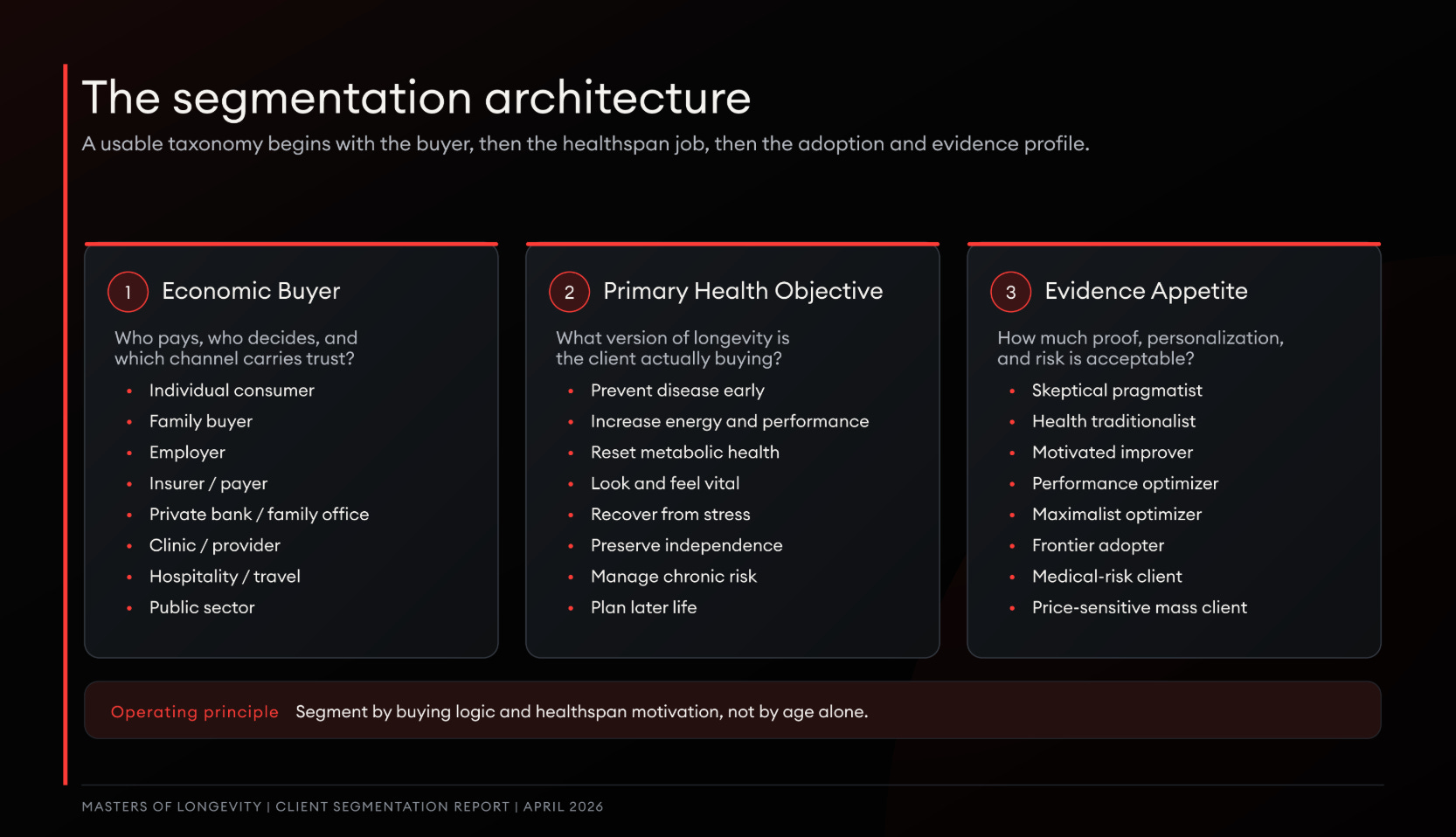
McKinsey research cited shows maximalist optimisers are roughly 25% of consumers but more than 40% of spend, while up to 60% of consumers across markets now rank healthy ageing as a top priority. The kicker: scaling proven prevention could generate $12.5 trillion in annual economic value by 2050, with two-thirds of impact from prevention. Yet Switzerland still spends just 1.9% of health outlays on it (and Australia 1.4%). Women’s longevity, the report insists, is a core market, not a wellness sub-niche.
The So What: Stop selling “longevity.” Start selling the specific kind of longer life each buyer actually wants.
4. How to make the food industry sustainable
This essay says the only way we’re going to change the food system is to make it profitable to be sustainable.
In 2021 Danone CEO Emmanuel Faber was kicked out by activist investors who thought you couldn't sell yogurts and save the planet at the same time. This has been a pattern - Annie's, Stonyfield, Honest Tea, Ben & Jerry's - prove mission alone cannot compete with spreadsheets and bean counters (and stock markets). The bean counters aren’t counting the right beans - soil health, nutrient density, and worker welfare are rounded to zero.
The way out is not another values pitch but a redirection of the profit motive itself. Rockefeller's True Cost of American Food estimated real food prices at roughly three times supermarket levels once externalities are tallied.
He proposes a two-part fix: establish the science showing living soils produce more flavourful, nutrient-dense food (eaters reliably pay for taste, rarely for virtue), and bake externalities into accounting standards so cheap conventional food stops looking cheap.
Do both and the regenerative cracker, sold at Costco on a four-crop rotation, becomes the most profitable cracker. The activist investor pushing for 20% growth is then unwittingly pushing for more rotation acres, healthier soil, and fairer farm labour.
The So What: The fix for purpose-driven food isn’t braver CEOs. It’s pricing what the spreadsheet currently ignores.
AI term of the week: Context Maxxing
A new Brookings paper describes"context-maxxing": using open-source agent harnesses (like OpenClaw) to control your own data, prompts, and AI workflows rather than handing context to the main vendors. The idea is that proprietary AI erodes cognitive agency by capturing user context while limiting reuse, whereas user-controlled setups build three reinforcing skills: specification, orchestration, and exploration. Worth a look if you want AI to amplify your thinking rather than absorb it. Lots of tutorials and videos around rolling your own second brain - would love to hear how people are getting on with it.
That’s all for now, happy weekend, everyone.
- Stephen