

Welcome to this week’s Four For Friday - nuggets of interesting things I’ve picked up this week, plus a cultural amuse bouche for the weekend.

1. Innovation as ongoing process, not shiny things
Have we got innovation all wrong? Perhaps it’s not about isolated genius and flashy product reveals (Steve Jobs in his black turtleneck), but a process for ordering chaos.
For decades, we’ve been trapped in “creative destruction”: innovation breaks things, government cleans up. But what if innovation was about creating coherence; about organizing chaos into new forms of coordination…
Innovation is a multi-player game. The key question isn’t what’s new and shiny, but who makes the rules. Today, tech companies become standards and set those rules. What if we all did?
Schools could shape AI in education, not just accept it. Hospitals could co-design AI systems. Cities could co-create mobility with public values built in.
When governments, schools, and civil society play rather than referee, they shape technologies instead of absorbing consequences. The game is only rewarding when everyone plays. Otherwise, it’s domination.
So what? If governments, foundations and corporates viewed innovation as a process where peers collaborate to overcome chaos, we’d go a long way towards addressing the increasing dangers of AI.
2. Bloody Genius
Turns out we’ve been flushing away diagnostic gold every month. Menstrual blood contains the same biomarkers as venous blood but nobody thought to test it because, well, periods. Now startups and researchers are developing at-home collection devices that could screen for everything from endometriosis to diabetes without a single needle stick.
The tech works. Early trials show comparable accuracy to traditional blood tests. The barriers? Getting the medical establishment to take period blood seriously as a diagnostic tool, changing consumer behavior, and convincing investors that half the population’s monthly routine might actually be useful. Revolutionary concept, that.
The So What? Accessible home diagnostics could catch diseases earlier while finally giving menstrual health actual medical attention beyond “take some ibuprofen.”
3. A digital twin of the US labor market
MIT’s digital twin of America’s workforce reveals AI can already do 11.7% of all jobs at competitive cost. That’s 151 million workers and $1.2 trillion in wages, concentrated in white-collar roles we thought were safe: finance, HR, legal, healthcare admin.
The comforting bit? Only 2.2% has actually been automated so far, mostly coding jobs. The less comforting bit? The capability exists now, we’re just waiting for economic triggers. Economists debate whether this means mass unemployment or just the usual creative destruction with better PowerPoint presentations. Either way, “my job’s too cognitive to automate” aged poorly.
The So What? The automation threat isn’t coming; it’s here and affordable. Question is deployment speed, not technical feasibility.
4. Four scenarios for the future of digital health
I don’t normally spruik my own book but this post about future digital health scenarios got some good discussions going. I look at two uncertainties that create four scenarios for the future of remote patient monitoring, and these scenarios can also apply to the field of digital health more broadly.
The first uncertainty is whether medical or consumer wellness models will dominate (i.e. will the wellness industry become as significant an economic player as the medical industrial complex is today), and the second one is whether ecosystems (health records, Big Tech) will be closed and proprietary, or whether open models (e.g. powered by large language models) will win out.
Of course everything is more nuanced and ‘it depends’, but these extremes help articulate four very different models of the future. Would welcome further feedback and discussion.
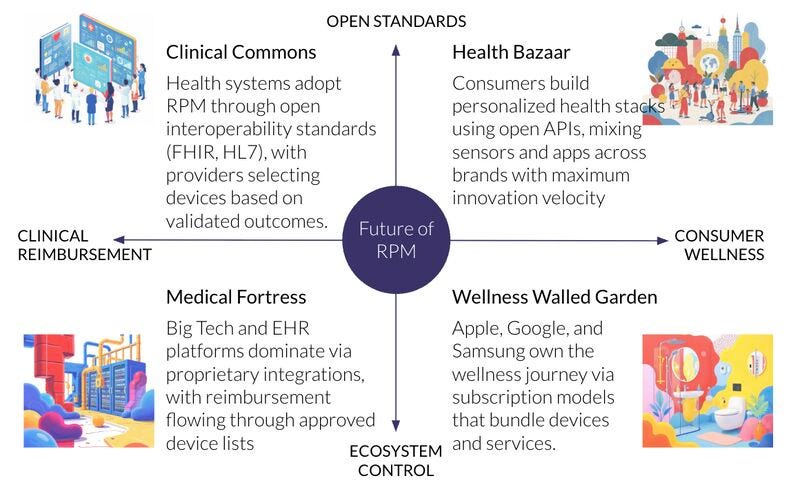
The So What? Scenarios are helpful tools for strategy making, especially those where both the industry itself and the regulatory and payor environment is moving fast.
+ Something-4-The-Weekend
Tired of the barrage of AI and tech tools. Me too, let’s take a break. Anyway, by now I’m sure we’ve all got our AI agents screening out new AI tools (don’t we?), so let’s try a bonus article on something more prosaic.
This is an original piece of content by the FT (reg may be required) - a video short story about a man wrestling with both memory loss and the tech industry’s ‘solution’ to it. Brilliantly written by David Baddiel and starring Stephen Fry, it’s worth 15 mins on a wet Saturday afternoon.
That’s all for now - happy weekend everyone.
- Stephen
Interesting piece on Project Iceberg (MIT)!
I just read key parts of the original study pdf on their website (I need to read again at micro level). My overall impression, as you stated & as the researchers indicated, is that there are so many dynamic independent variables in play now, most of which have the capacity to be changed in various ways (and inevitable will be?), thus changing the projections here. Along with their emphases on correlational vs. causal.
I would like to see even more pieces that go in the direction of this one, exploring task displacement vs. entire role/"job" displacement. It seems like that's a worthy Venn diagram for individuals to think from - which parts of your job are likely to be automated, which are not, and almost fashion new ideas of roles moving forward. Just spit balling here.
Super fascinating to read and ponder though, thank you Stephen!