

Welcome to this week’s Four For Friday. Four topical stories focused on healthspan, systems change and AI for impact. Enjoy!

1. Americans are all-in on longevity products
Andreessen Horowitz’s new report on longevity included a survey of 500 Americans, and found a nation healthmaxxing with gusto, if not always with data.
Wearables everywhere, action nowhere: 54% own one and 83% of those check it daily, yet 55% say it has never changed their behaviour or prompted a doctor’s visit.
Non-toxic everything: 63% now know about microplastics and 62% would pay more for “non-toxic” labels, evidence notwithstanding. 70% filter their water.
The healthcare home: a16z identity a race to build the “Muse for healthcare”, one app that holds your records, orders your labs and books your care. Half of respondents would pay for it.
Peptides for all: the unregulated market is single-digit billions; Lilly’s tirzepatide made nearly $44bn in nine months.
Brain tech: 39% would try a non-invasive device for sleep, focus or mood.
The So What: Longevity’s spoils go not to whoever turns health data into action and shows credible impact.
2. Australia gets catalytic capital
Australia’s philanthropies are organising to build a market. Hand Heart Pocket, the Minderoo Foundation, the Paul Ramsay Foundation and the Snow Foundation have launched Catalytic Capital Consortium Australia, announced at the GIIN Impact Forum with the MacArthur Foundation, architect of the original US consortium. The starting pool is A$10.5m in grants, managed by Paul Ramsay, funding evidence and market infrastructure rather than deals themselves. The gap is real: about A$100m of catalytic capital has been deployed in Australia in three years, under 1% of the assets of the country’s leading impact investing foundations. MacArthur says its own US$128.5m field portfolio has crowded in roughly US$3.1bn, leverage of about 23 times. Expressions of interest open in February.
The So What: Philanthropy is moving from funding deals to manufacturing the proof that brings commercial capital in.
3. US democracy propped up by a fragile non-profit
This was a great week for those who believe in democracy in the US (even if much of the shift was about rejecting cost of living increases, not incivility). How much of the result was due to Ukraine bombing Russian disinformation factories? Who knows. Another player in the info wars is Democracy Works, a small Brooklyn nonprofit. This group supplied election information to ChatGPT, Claude and Google’s AI tools ahead of the midterms, NBC reports.
The group has become the go-to provider of accurate voting data for the biggest chatbots, a piece of civic plumbing inside the world’s biggest models. Yet it says it is struggling with funding and is not sure it will survive until 2028. The companies that depend on its data apparently do not depend on it enough to endow it.
The So What: The AI industry’s election infrastructure is one small nonprofit’s funding round away from gone.
4. Endometriosis on the brain
One of the most interesting collaborative areas to emerge with the Bathroom OS work is both the importance, and lack of innovation in, endometriosis. This fascinating article identified how a woman was having seizures every month which doctors finally concluded was uterine tissue implanting in her brain.
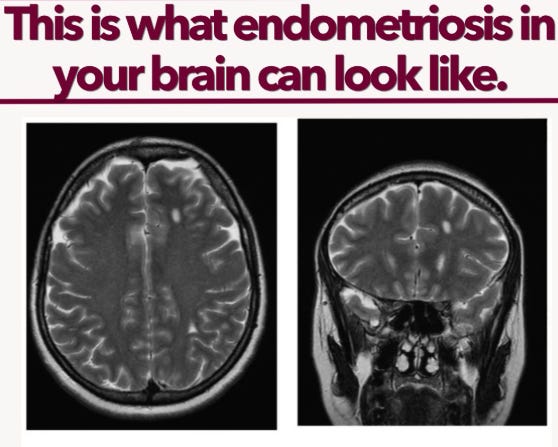
Neurologists and other specialists don’t generally think about hormones - they focus on their speciality - yet up to a third of women with epilepsy have seizures that track their menstrual cycle. The average diagnosis takes 8 years!
This seems like a compelling ‘systems fund’ opportunity, as there are multiple research, education and awareness levers to pull including:
Tech and research breakthroughs: Challenges in diagnosing, no biomarker, no blood tests. It looks like a tumour on MRI - so you need surgery to get a biopsy.
New treatments needed: Primary treatment today is blanket hormone suppression - telling the body to stop making oestrogen.
The So What: There’s a big opportunity to systemically address this under-studied phenomenon negatively impacting at least 10% of women of reproductive age.
That’s all for now — happy, safe weekend, everyone.
Stephen