

Welcome to this week’s Four For Friday. Four topical stories focused on healthspan, systems change and AI for impact.

1. Today’s billionaires need to build, not just donate
As we’ve talked about in these pages before, there’s a wave of new philanthropic money arriving, as a result of baby boomers’ wealth transfer and new AI riches. This piece in SSIR argues that there’s a lack of imagination and ambition behind today’s billionaire class.
Leland Stanford turned 8,180 acres of horse farm into a university. Andrew Carnegie seeded 2,509 libraries. Today’s plutocrats, argues the piece, mostly top up endowments their predecessors built: the Forbes 400 holds $6.6 trillion, yet the money flows to Harvard (endowment: $50 billion) rather than to new civic machinery. Having been lucky enough to spend a couple of years at Harvard Business School, I found it rather amusing and very nice that we had shiny new buildings popping up seemingly every month. Now it just feels as though those with massive wealth are missing a trick.
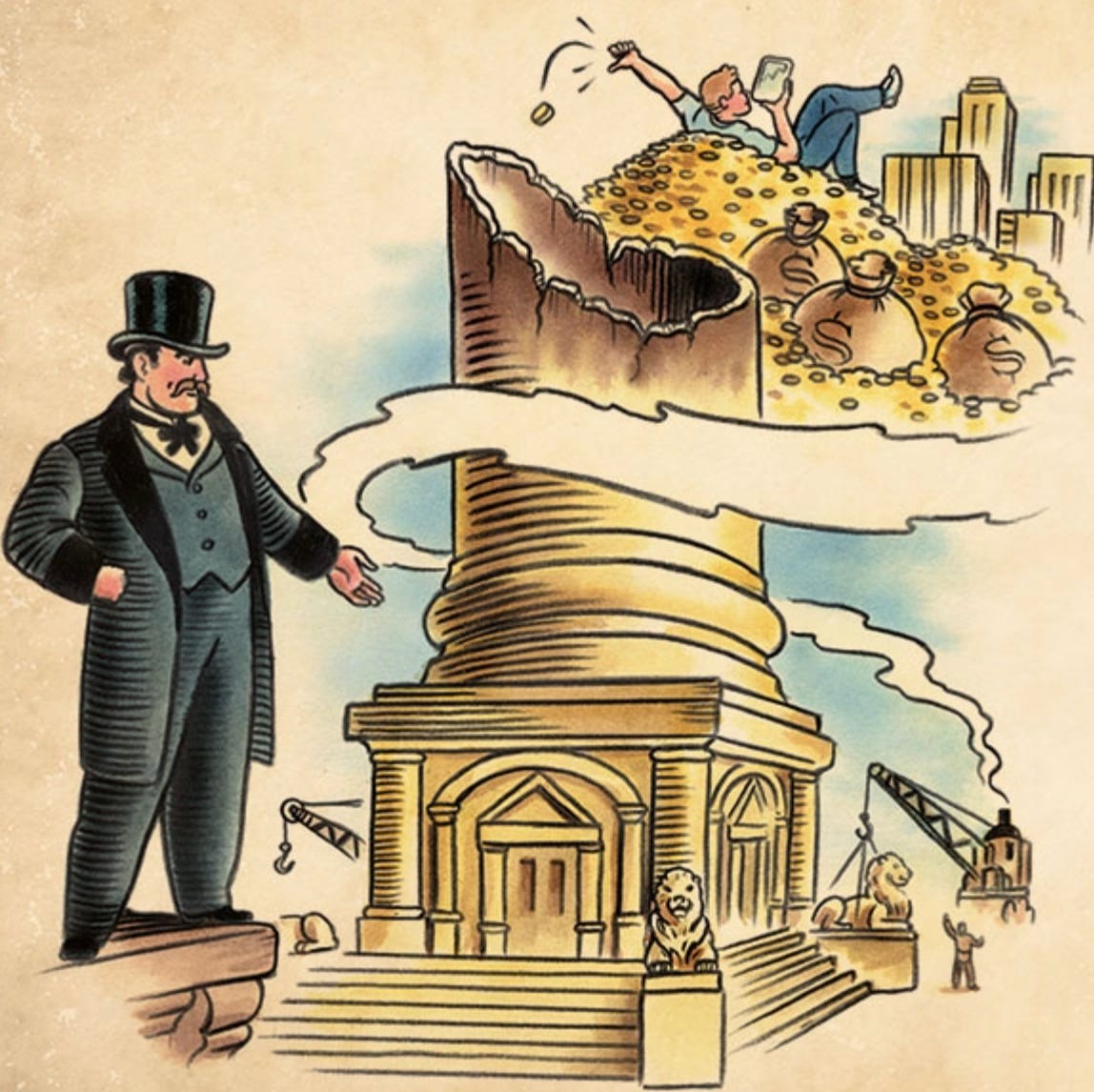
There’s more than enough need for fixing today’s civic scaffolding. Confidence in American institutions sits at 28%, more than 150 rural hospitals have closed since 2010 and roughly 2,900 newspapers have folded or merged. Spend-down pledges and (dare I say MBAs and) metric-obsessed giving favour quick wins over patient bets, such as the Rockefeller Foundation’s funding of Norman Borlaug’s wheat research from 1944, which took two decades to double yields in famine-threatened India and Pakistan and saved millions of lives.
The So What: Capital is plentiful; the scarce resource is billionaires willing to build, not donate.
2. A common gut microbe may help fight heart disease
A study in Nature reports that a common human gut bacterium, Bacteroides uniformis, makes pentadecanoic acid. In mice, the compound cut arterial plaque by about half. It acts on the same liver enzyme that statins target, which prompts the liver to make more LDL receptors and pull cholesterol from the blood.
The team also checked blood and stool from more than 200 human donors. People with high blood fats had lower levels of the molecule, and people with heart disease carried fewer of the bacterial genes that make it.
The So What: If it holds in people, diet or microbiome treatments could help the nearly half of advanced heart disease patients whom statins alone do not get to target.
3. What’s after social media?
Social media is having a drubbing, and rightly so - the negative externalities around mental health, and its particularly pernicious impact on children are finally being recognised by the public, and courts. In parallel, the space itself is changing and this preprint suggests three shifts:
recommendation by interest rather than by who you follow, which turns users into viewers
generative AI replacing user-generated content with synthetic media, and
a move from public platforms to closed spaces.
It says scholars need new concepts for communication systems that no longer need human participation.
The So What: If the feed is becoming synthetic, the people measuring public opinion need new instruments.
4. Three failures of capitalism, and a better path forward
I just rediscovered this TED talk from a few years ago, and it’s absolutely on the money. It lays out the argument from Nick Hanauer, a billionaire, about why the current system that delivered billionaires like him is failing.
Capitalism today rests on three false beliefs: that markets are efficient and balance themselves out, that price equals value, and that people are selfish.
Put those three together and you get wealth piling up at the top while the middle thins out. He proposes a rethink. Prosperity should be about the rate at which we solve human problems. Economies are gardens to be tended - not wild, winners-take-all jungles. Inclusion drives growth. Firms serve all their stakeholders. Greed is not good. Above all, the rules are a choice, and a choice can be remade.
The So What: We have lived too long assuming unfettered markets are both a law of nature and a necessity; neither is true
That’s all for now — happy, safe weekend, everyone.
Stephen