

Welcome to this week’s Four For Friday. Four topical stories focused on healthspan, systems change and AI for impact. Somewhat tardy shipping this week, apologies!

1. The One Nation vote is a map of government neglect
Australia is a wonderful country, but, for good and bad, often finds itself about a decade behind the US. This can create fabulous opportunities, for example startups that arbitrage winning ideas, but it also imports politics, such as the current surge in populism. Learning from the US and fixing things before they poison the discourse should be a top priority here. It’s unclear whether the lessons are being learnt.
Kos Samaras makes a strong case that the country’s populist surge tracks material neglect - in particular government failure - more than culture-war noise.
Matching the new Zurich/Mandala Resilience Index (two million data points across 2,000+ communities) to federal seat modelling, he finds an electorate’s health resilience alone explains 63% of variation in the One Nation vote.
Fifty of 53 projected One Nation seats sit in the bottom three-fifths on health; none sit in the top fifth. Average hospitals within 15 km: five in One Nation seats versus 38 in Labor/Coalition seats.
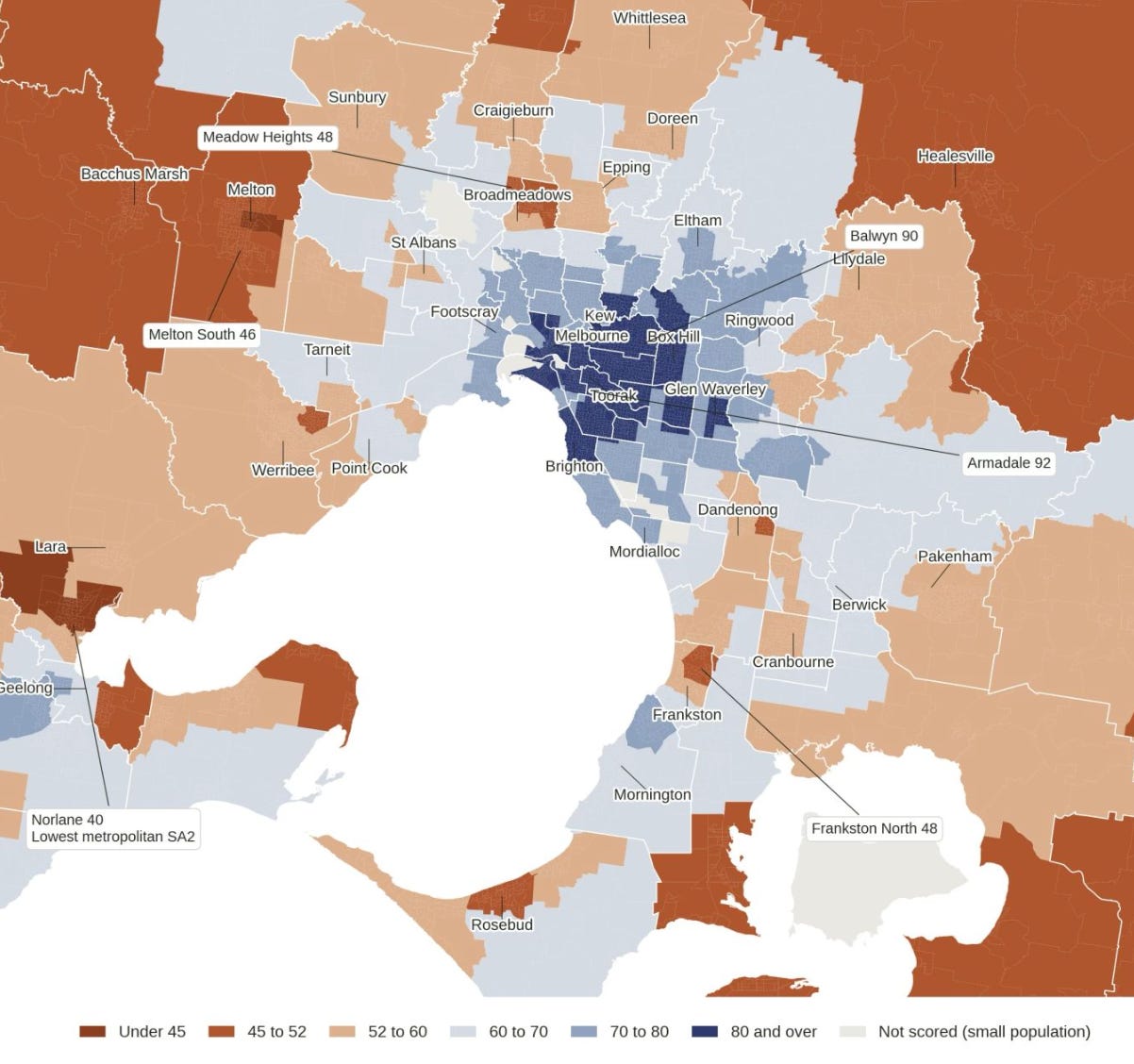
The practical lesson: Design health and infrastructure around lived experience in each place; tobacco excise that works in one suburb stops being a tax on the poor and a gift to the black market in another.
The So What: Political volatility is often a delayed symptom of failing public infrastructure — fix the building blocks, and the map of anger may move.
2. AI connects climate data to clinical care
A Deloitte podcast connects three of LookingForward’s favourite topics: health, climate and AI, and find imporant links.
During California’s 2020 wildfires, Chethan Sarabu, a paediatrician now at Cornell Tech, found that his electronic health record knew nothing of the air his asthmatic patients were breathing. His fix? A hackathon.
Last September’s New York edition drew 150 participants from over 70 institutions. In one weekend they built working prototypes, including a heat-risk dashboard for employers of outdoor workers and a tool mapping pharmacy deserts against climate vulnerability.
LLMs excel at connecting silos into ecosystems, stitching together weather, wearables and health records. Some 60 to 70 common medications, diuretics among them, turn riskier in a heatwave, which few clinicians know. London and New York events are following and they’re looking to create an incubator.
The So What: The weather forecast should be in the medical record and AI can put it there.
3. Europe’s cities are heating faster than they are adapting
The Lancet Countdown’s first city-level report, covering up to 885 European cities, has some alarming stats:
Heat-related mortality rose in 98.7% of the cities assessed - an average rise of 82 deaths per million a year; southern cities fared worst.
Dengue transmission risk more than doubled (up 369% in eastern Europe).
Heat reduces labour supply by 1.1%, or about 17 hours per worker annually.
Only 14% of cities meet the 30% tree-cover target.
Just 0.5% of planned climate projects address health systems.
On the upside, there are a few glimmers of progress:
Emissions per head are falling and PM2.5 (small particles in air pollution) deaths are down 40% since 2000.
The So What: Cities deliver most of Europe’s climate policy, yet health barely features in their plans.
4. Collective stupidity = security threat
Machines are getting smarter while their owners are getting dumber, says Geoff Mulgan.
IQ scores have reportedly been falling this century in Britain, Germany and Denmark; PISA results peaked in 2012. A quarter of adults in rich countries, and 35% of Americans, cannot use mathematical reasoning to judge whether a statement is valid.

Adversaries have taken note: Russia reportedly spends $2bn a year on cognitive warfare, China nearly $10bn.
Britain’s new National Centre for Information Defence follows Sweden, France and Moldova. Mulgan prescribes “cognitive rearmament”: critical thinking from primary school, as in Finland, adult education via public broadcasters, and laws against industrial-scale lying. Ageing economies, reliant on productive over-50s, have most at stake.
The So What: Brain health is becoming defence policy, and the longevity economy should be part of this discussion.
That’s all for now — happy, safe weekend, everyone.
Stephen