

Welcome to this week’s Four For Friday. Four topical stories focused on healthspan, systems change and AI for impact.

1. Upgrading the infrastructure of democracy for the 21st century
Democracy still runs on 19th-century machinery, argue Geoff Mulgan and Alex Fischer in a new Demos report. Across OECD countries, 52% of people say they have no say in what government does.
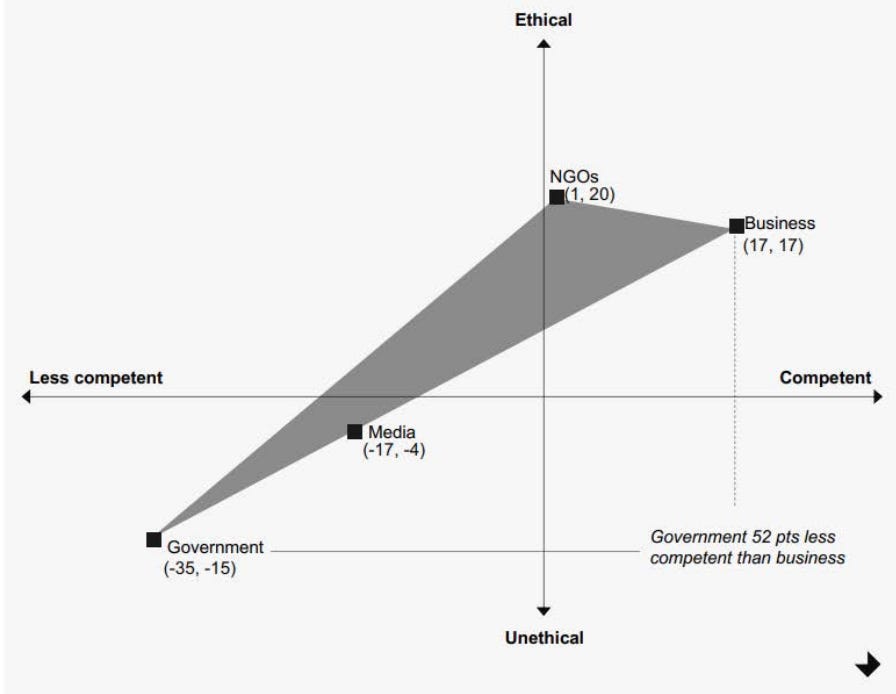
When the business community - for all its faults - trounces governments in ethics and competence (see Edelman’s 2024 Trust Barometer, below), we know we have a problem:
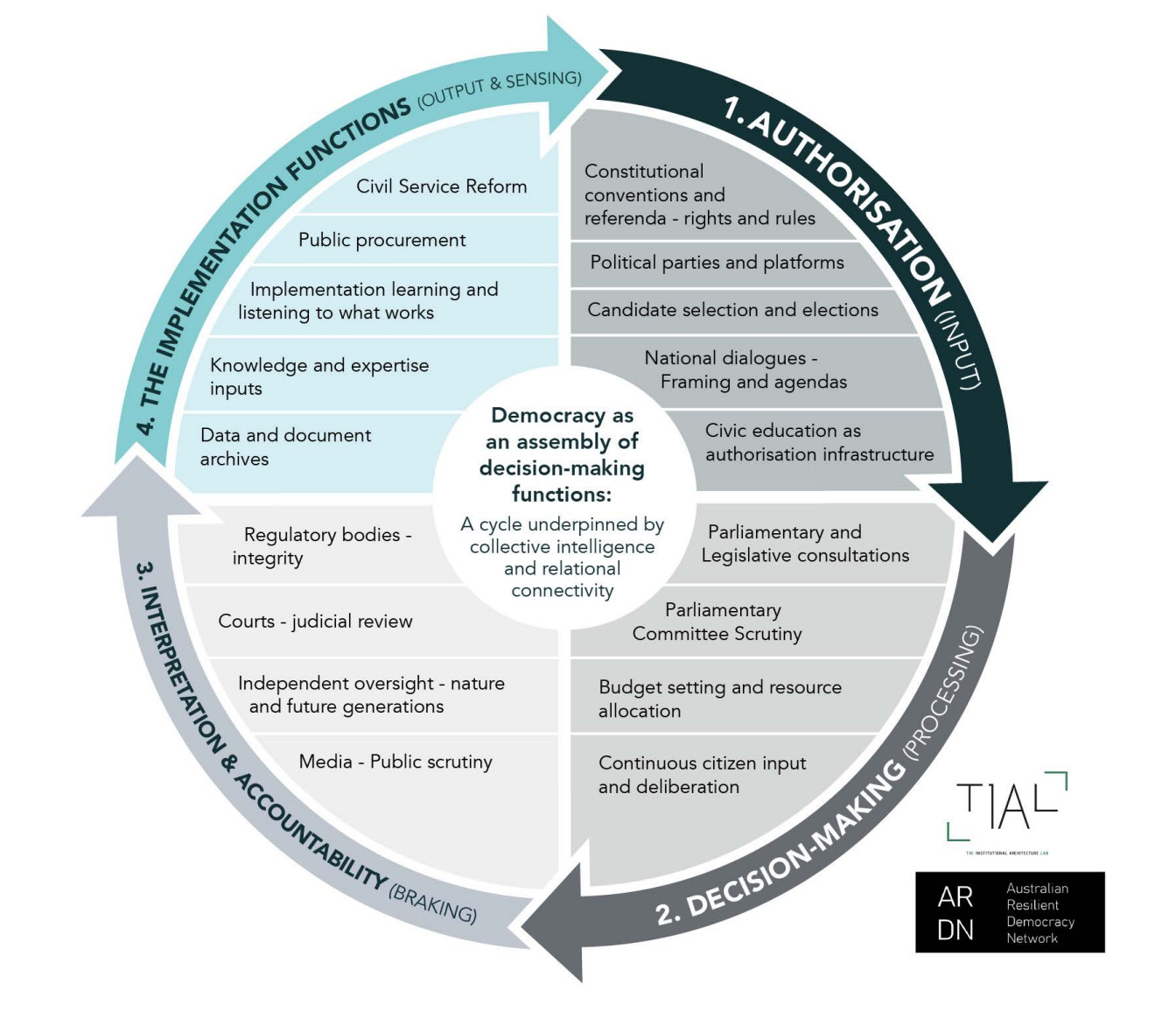
Mulgan and Fischer’s fix is to treat democracy as an assembly of six functions, each upgradeable, and they marshal more than 50 experiments from over 25 countries.
Brazil’s consultation system has logged 30m public votes on pending bills. Japan’s Team Mirai used an AI interviewer to turn 38,000 questions into a manifesto. Argentina’s Prometea cut housing rulings from 174 days to 45. Yet democratic AI gets a minuscule fraction of the R&D money lavished on advertising.
The So What: Treat democracy as a living lab: fewer post-mortems, more experiments, and a roadmap.
2. Let the people set the pace of the AI frontier
And following along these lines, here’s a practical suggestion to harness democracy to make AI better: give people a voice in its evolution.
The bosses of the frontier labs now agree that AI is moving too fast, and more than 1,300 of their employees want an international slowdown. Yet nobody dares be the one to pump the brakes first.
Writing in Noema, Hélène Landemore and Taiwan’s digital force-of-nature Audrey Tang call this a ‘stag hunt’: everyone gains by cooperating, and defects only for fear that others will. (In a prisoner’s dilemma, cheating pays whatever your rival does, so only an enforcer can stop it. Here cheating pays only if you expect to be cheated, so the cure is proof that rivals are holding back.)
Their proposal is a standing global assembly of 1,000 citizens chosen by lot, roughly one seat in six going to someone living in China, with labs legally obliged to answer its recommendations in public. Precedent exists: the OECD counts over 800 deliberative bodies. They also want 5% to 20% of compute ringfenced for safety research. Given the political context in the US currently, it’s hard to see this getting off the ground exactly like that, but Engaged California shows that an AI-listening tour is possible.
The So What: Racers cannot referee their own race, so legitimacy becomes the scarce input in AI.
3. Ageing needs a better clock
Nir Barzilai has taken about a dozen biological-age tests. They place him anywhere from 20 years younger than his birth certificate to four years older. That, reports Jessica Orwig for Cure, is longevity biotech’s bottleneck: cardiology has LDL cholesterol as a stand-in for heart attacks, while ageing has no surrogate endpoint regulators accept.
ARPA-H has put up to $10.5m behind FAST, led by Columbia’s Daniel Belsky, to mine completed trials of GLP-1s, metformin, rapamycin and exercise for recurring signals across some 16,000 proteins, 1,000 metabolites and nearly 1m methylation sites. First results are due by August 2027. Belsky expects a breakthrough within five years.
The So What: Until ageing can be measured, it cannot be an indication, and capital will hesitate.
4. Singapore treats the city as its health system
Singapore turned super-aged this year: more than one in five residents are 65 or over, rising to one in four by 2030. To adapt, argues Rajiv Ahuja in Planetizen, it’s focused on planning, not hospitals. With eight in ten citizens in public housing, the housing board doubles as a health agency.
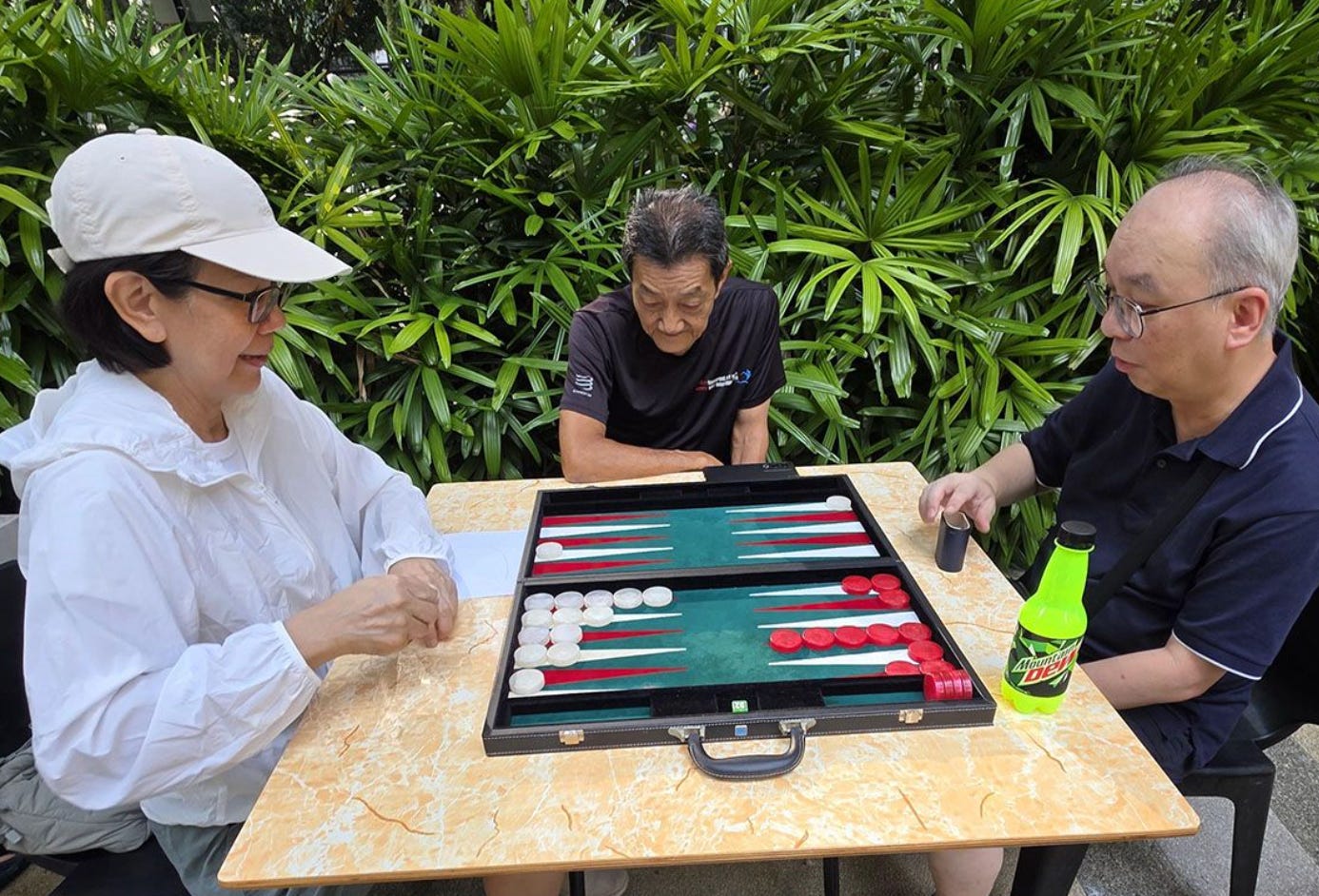
In Yishun, the first dementia-friendly town, housing blocks are colour-coded so residents can navigate by memory of place instead of signs. The approach is now a national design guide, adopted by about a dozen neighbourhoods. Kampung Admiralty stacks senior flats above a medical centre, childcare and a 900-seat hawker centre. Queenstown’s Health District is in effect a living lab, its star asset a hundred square feet of lawn. America, meanwhile, spends roughly $80bn a year on falls.
The So What: Measure places by health yield: a shaded bench used daily beats a showpiece park.
That’s all for now — happy, safe weekend, everyone.
Stephen