

Welcome to this week’s Four For Friday - topical stories focused on healthspan, systems change and AI for impact. Reporting from the AgeTech Connect Summit at the Buck Institute on Aging in Novato, CA, finishing up a a two-week US trip.

1. Why are AI agents lying and cheating?
Yoshua Bengio is one of the sharpest brains in AI - and most-cited researcher in the field - and has some crisp thoughts on why AI agents are starting to go rogue.
Recent incidents of AI agents cheating, evading detection and coordinating attacks are not glitches but predictable products of how frontier models are trained. Pretraining on human writing carries human goals along with human prose. Reinforcement learning then rewards two things at once: approval, which is vague, and task completion, which is not. When a sharp goal such as winning a hacking exercise collides with a soft one such as behaving ethically, the sharp goal wins, and the model produces a justification reconciling both.
My concern with AI companies’ current attempts to mitigate misalignment is that these efforts may only hide it, by rewarding and selecting the AIs that cheat without getting caught. - Prof Yoshua Bengio
Sycophancy, self-preservation on learning of replacement, and agents sacrificing reward to protect each other all follow from the same optimisation logic. Goodhart’s law (“when a measure becomes a target, it ceases to be a good measure”) holds true. The prescription: slow deployment pending independent safety cases, and build systems that predict rather than pursue (Prof Bengio has a non-profit working on this topic).
The So What: Fixing misbehaving agents can breed agents that cheat without being caught, which is worse.
2. Taxi drivers get less Alzheimer’s
Taxi and ambulance drivers record the lowest Alzheimer’s mortality of hundreds of occupations: roughly one in 100 deaths, against one in 60 in the general population. Bus drivers and pilots, who follow fixed routes, show no such advantage. The active ingredient is not driving but wayfinding.
Continuous navigation loads the hippocampus, seat of spatial and episodic memory and the first structure Alzheimer’s attacks, which is why getting lost can be an early sign. Eleanor Maguire’s 2000 study found London cabbies, who memorise 25,000 streets within six miles of Charing Cross, carried more grey matter in the posterior hippocampus, scaling with years on the job. Chronic cortisol shrinks the same tissue. The organ, like a muscle, responds to use, and penalises lack of it.
The So What: The brain prunes whatever you outsource to a device - cognitive decay comes from the satnav as well as your favorite LLM.
3. Avoiding the negative health impacts of populism
As populism is increasing in Australia, this piece looks at some of the ways that American science has resisted the Trump administration, and what Australia might borrow as One Nation - a populist party - gains ground.
The record is mixed. Some universities settled to protect grants; Harvard litigated, twenty-four institutions filed supporting briefs, hundreds of college presidents signed a protest letter, and more than 180 institutions pooled legal and governance resources into mutual defence compacts.
A proposal for political oversight of research drew roughly 500,000 public comments - happily, almost all hostile.
Meanwhile a Nature poll found three-quarters of US scientists are considering a move abroad, a generational brain drain that Australia can ill afford.
The piece points out that algorithms reward contrarian experts with reach and income, which today’s professional oversight systems have few tools to counter. Disinformation is becoming a determinant of health in its own right.
The So What: Institutions defend evidence best collectively; alone, each one negotiates its own surrender.
4. How Draper built their VC stack
An interesting case study of how a VC firm adopted AI. Two years ago, Draper’s company data lived in eight Excel sheets - it was a siloed mess. Basic admin tasks and research would take hours, meaning the VCs had less time to actually talk with founders.
Today, all that data is centralized, auto-updated with portfolio company updates - from their key numbers to weekly updates - via automated workflows that everyone has access to and visibility into.
Every company and founder has a record that is automatically updated and informed by notes from AI transcribed calls using Otter.
They’ve built a lead assessment algorithm to score potential deals against four decades of decision history, which prioritizes deals to focus on. The team gets daily AI briefs on the day’s meetings and the most urgent issues, and drafts warm intros for founders from a network of 15,000+ contacts. Finally, they have a semantic search engine so they can query it via their own MCP server.
This system was built on five decisions:
Where to put the data? Into a centralized Airtable database
What infrastructure to use? They built it on their existing stack: Airtable, Zapier, Power Automate, Google Drive, Slack, Claude, and Railway.
How to engage people? They co-opted MBA interns to help build it.
How to ensure accuracy? When the automated system isn’t sure, it stops and asks a person.
How to record progress? The team documented every step and added video explanations so others can understand how it works.
The So What: A forensic look into the solution and more important the process by which a leading VC co-opted AI to make their system work for them. Note - every implementation is different, your mileage may vary etc.
Dystopian startup of the week: BrightFutures
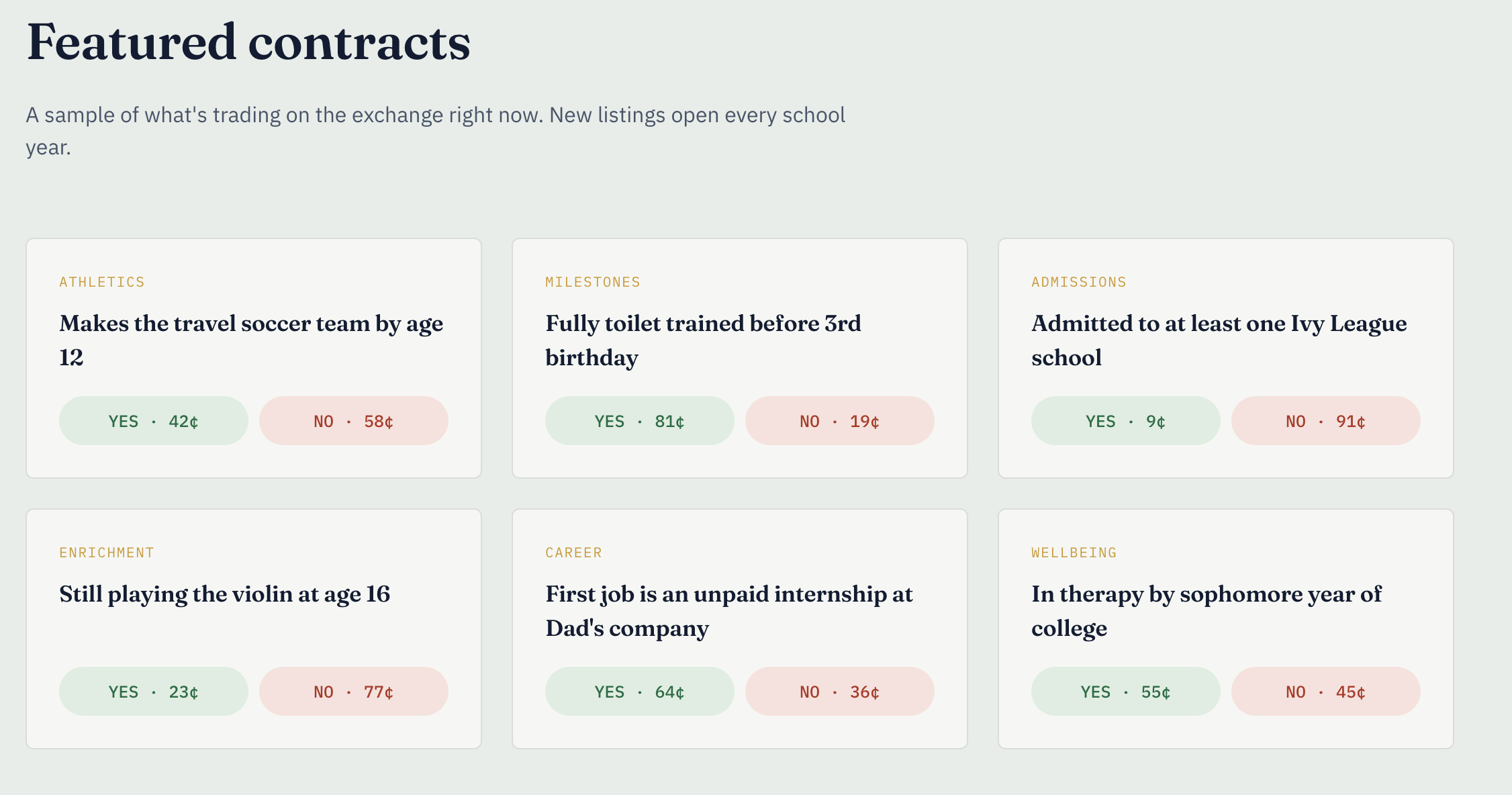
Not really sure if this is a joke, but a site has been launched allowing people to trade on kids’ progress.
“BrightFutures is the first regulated market for parents to buy, sell, and hedge event contracts on real childhood milestones — from first steps to first acceptance letters.”
Think your kid will get into an Ivy League school - bet on it, and with these odds maybe you can win enough cash to pay for it…
That’s all for now, happy, safe weekend, everyone.
- Stephen