

Welcome to this week’s Four For Friday. Four topical stories focused on healthspan, systems change and AI for impact. Enjoy!

1. Unravelling democracy
The 10th annual edition of the V-DEM Democracy Report has landed, and it’s not comfortable reading.
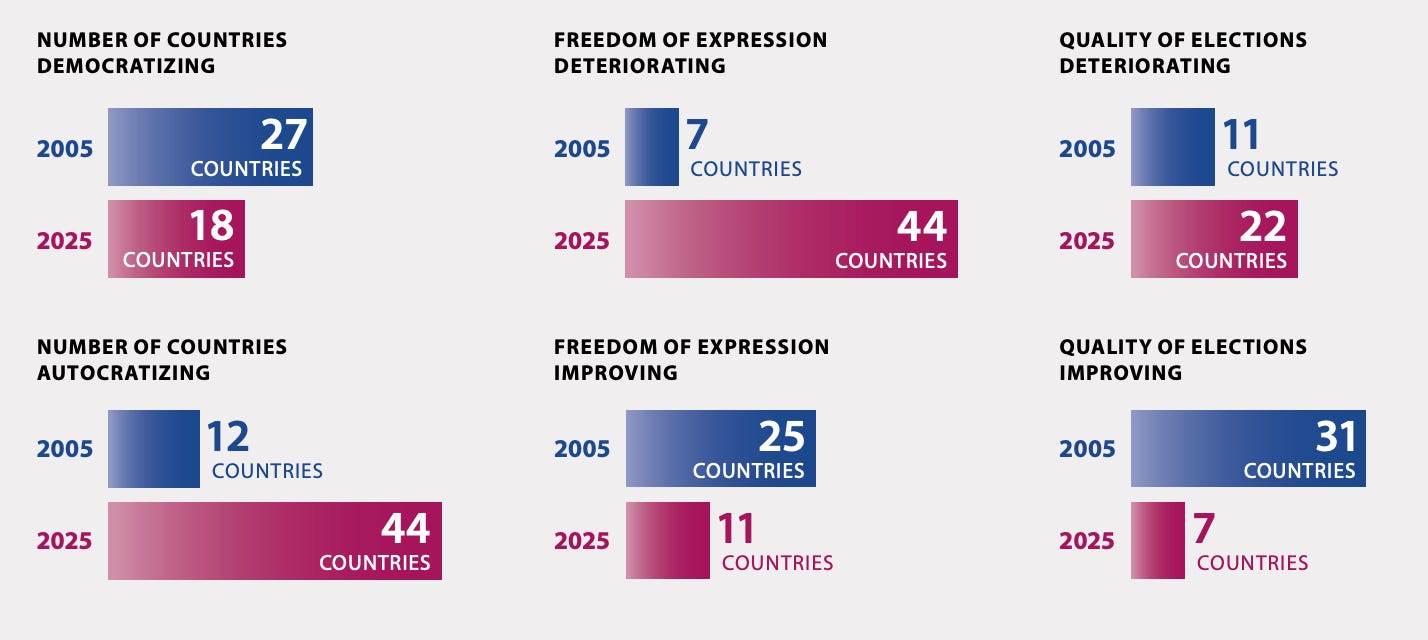
Democracy has slid back to 1978 levels for the average global citizen. 74% of the world population (6 billion) now live in autocracies.
The level of democracy for the average citizen in Western Europe and North America is at its lowest level in over 50 years, primarily due to ongoing autocratization in the USA.
The USA has lost its long-term status as a liberal democracy – for the first time in over 50 years.
Only 7% of the world population (0.6 billion) live in liberal democracies.
Freedom of expression is the hardest-hit: 44 countries are declining in 2025.
Torture is now increasingly used to suppress political opposition – 33 countries are substantially degenerating in 2025.
The world has never before seen as many countries autocratizing at the same time - 41% (3.4 billion) of the world population currently live in autocratizing countries.
Among the new autocratizers are five European countries: Croatia, Italy, Slovakia, Slovenia, and the UK.
The So What: If most people now live under autocracy, every healthspan, climate and AI-for-impact bet needs to factor in a democracy discount / autocracy premium.
2. Making a market for clean cement
Cement accounts for 7 to 8% of global CO2 emissions; if the industry were a country, it would be the fourth-largest emitter on Earth, behind China, the United States and India. Yet cement and concrete drew less than 1% of climate-tech venture capital over the past five years.
This week Renaissance Philanthropy launched the Aggregate Fund, anchored by $10.2m from Builders Vision (a regular in these pages), to fix the market rather than the chemistry: five years of regional accelerators, starting in the US, getting low-carbon products approved and specified, converting scattered buyer interest into commitments producers can bank on, and pulling catalytic capital in behind them. The premise is that the technology already works. What has been missing is organised demand.
The So What: Decarbonisation needs better markets not just tech; philanthropy that aggregates demand may cut more carbon than another tech pilot.
3. McKinsey outlines the $16 trillion healthy living opportunity
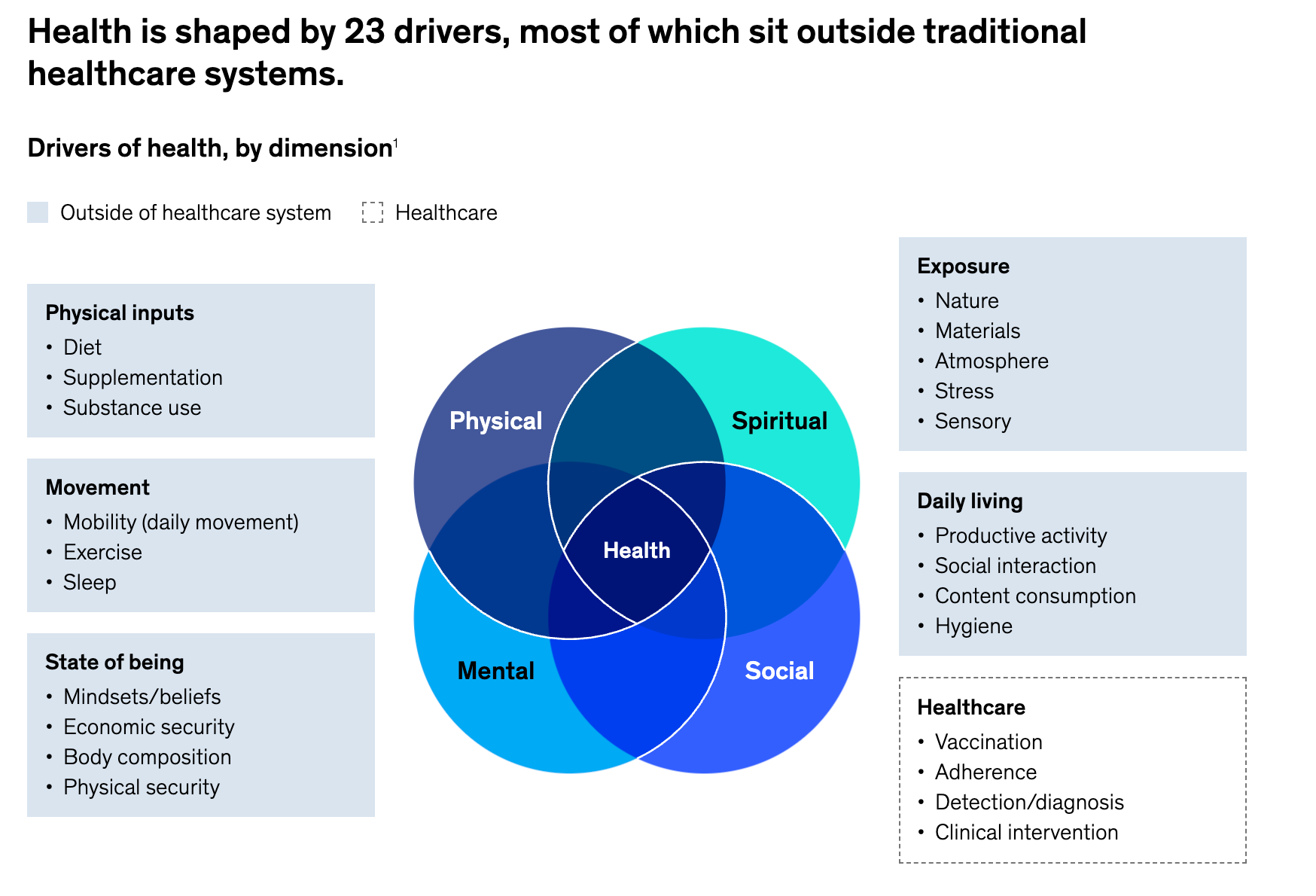
Spoiler alert: 19 of the 23 drivers of health sit outside the traditional healthcare systems. McKinsey Health Institute, with Abu Dhabi’s Future Health / Healthy Living programme, puts a value on prevention: wipe out modifiable behavioural, metabolic and environmental risks and global GDP in 2050 could be US$16.4 trillion higher (~9% of projected GDP).
The report argues that prevention is macroeconomic policy. Doing everything right could add twelve years to healthy life expectancy at birth. But their model eliminates every modifiable risk at once, so take it with a grain of salt.
The baseline is grim: people spend roughly half their lives in less-than-great health. The delivery examples are refreshingly small-bore: Singapore’s National Steps Challenge signed up 1.3 million people, a quarter of the adult population, with a free tracker and voucher points; participants added roughly 1,500 steps a day.
The So What: The money in prevention sits outside the clinic, in food environments, measurement and incentives, and no one in government owns that agenda yet.
4. Elephants self-medicate
On Mount Elgon in Kenya, elephants don’t just forage - they appear to self-medicate. Their menu - 35 plant species and several soils/clays; 87% of those resources also sit in local human medicine.
For eight of them, visibly sick elephants sought out specific remedies, and mothers mixing plants with milk act as a kind of “immunisation” for calves. The authors are careful (putative, anecdotal, n=8 experts), but the overlap with ethnomedicine and unusual feeding patterns points to intentional, socially transmitted care — and to habitats that double as pharmacies.
The So What: Protecting elephants’ habitats isn’t only about charismatic megafauna; it may be conserving a living pharmacy that humans could also benefit from.
That’s all for now - happy, safe weekend, everyone.
- Stephen