

Welcome to this week’s Four For Friday - topical stories focused on healthspan, systems change and AI for impact. Happy reading!

1. $150m in big ideas for a San Francisco glow-up
Sequoia Capital’s Michael Moritz and his wife writer Harriet Heyman have put up $150m for an open global call for ideas to improve San Francisco. Having lived there for 5 years, I was constantly surprised by the disconnect between the unbelievable wealth of the people and the decaying fabric of the city. This is much needed, and somehow appropriate that funding comes from one of tech’s OGs - he invested in Google, YouTube, LinkedIn, Stripe and many more.
The programme uses an open call, peer and expert scoring, then up to seven finalists will receive $250,000 to $500,000 in 2027 to sharpen their proposals, before three winners take up to $50 million each.

Any subject is on the table, from housing to public health, provided the benefit lands primarily in San Francisco. Moritz’s foundation, Crankstart, has given $1.8 billion since founding, over half of it in the Bay Area.
The So What: A welcome move from a city beset with problems, and a good model for other philanthropists to adopt - opening up to different ways to solve problems, rather than mandating the solutions.
2. Congestion pricing reduces ambulance response times in NYC
File this in unintended consequences, but it’s obvious if you think about it. In New York, since the introduction of congestion pricing, ambulance response times have improved by almost 1 minute from an average of 12 minutes, so an 8% increase in speed.
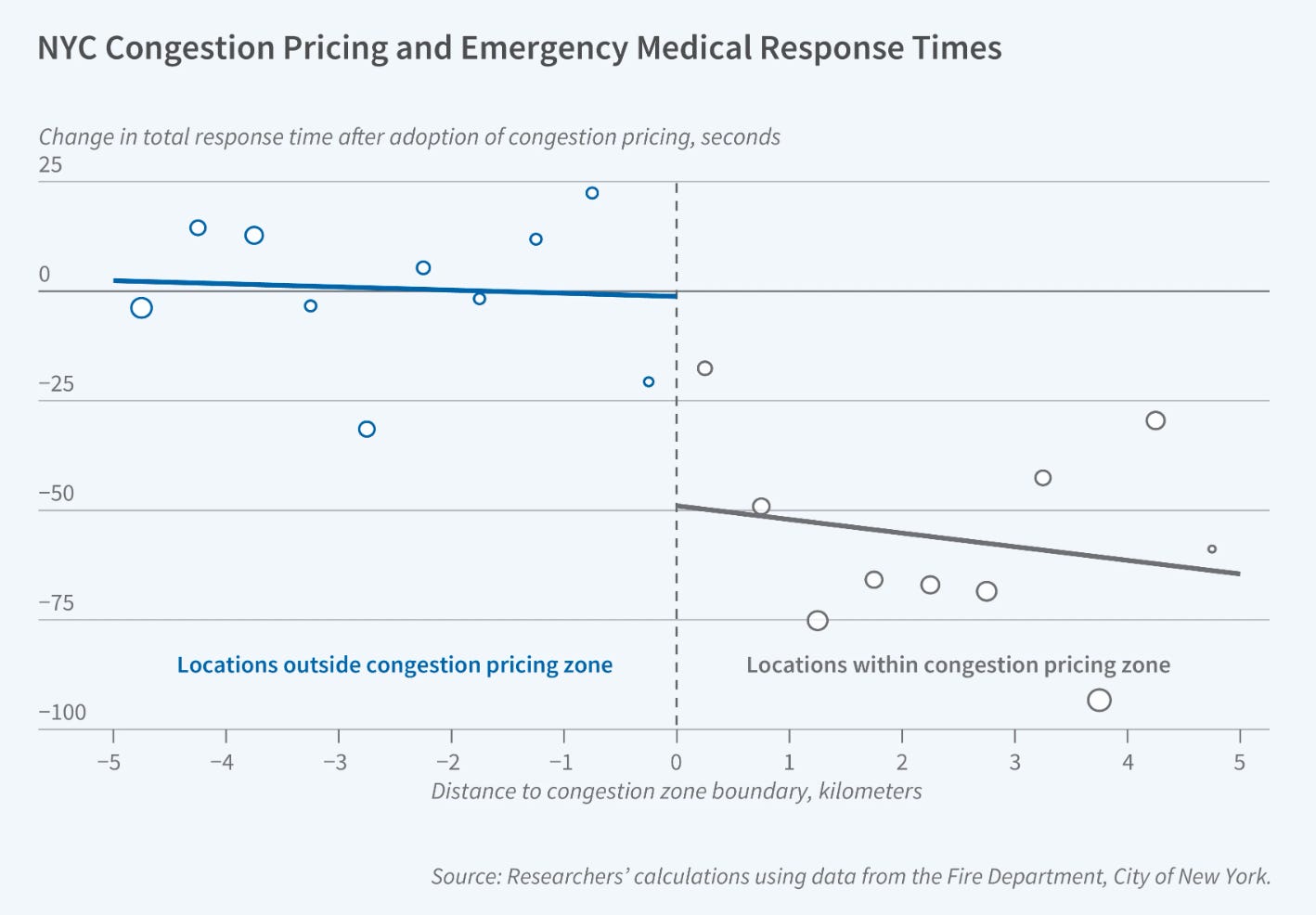
If you’re in the back of one of these ambulances, those seconds are probably worth a whole lot.
The So What: While congestion pricing is aimed mainly at reducing cars and congestion, the second-order effects will be multiple. Am looking forward to seeing the health and environmental benefits.
3. Catalytic capital - the key to systems change
This article suggests there are two benefits of ‘catalytic capital’ (capital that accepts below-market returns or higher risk for where commercial money will not go). The first, is crowding in regular capital. By de-risking projects, this approach could mobilise up to $286 billion in private investment.
While this is fairly well understood, what’s less obvious is that the mere act of establishing new relationships - the connective tissue that bridges different types of capital provider and innovation projects - itself delivers significant benefits. This is the ‘orchestration’ function - often overlooked and rarely funded. But essentially the act of creating catalytic capital is itself catalytic. Assembling public, private and philanthropic stakeholders around a capital structure builds trust and norms that have ripple effects and outlive any particular deal. The article suggests that without embedded impact objectives, though, catalytic capital drifts toward safe deals mainstream investors would have funded anyway.
The So What: Catalytic capital’s real benefit is not just cheap money, but the public good benefits of orchestration and alignment.
4. Bank of Singapore on the longevity economy
THe Bank of Singapore’s 2026 Supertrends puts the longevity economy at $3 trillion today, growing at 6 to 7% a year to $5.4 trillion by 2034. That is comparable to a top ten national economy.
Healthcare takes roughly 40% of it. This is a global issue but acute in Asia: by 2035 over 20% of China’s population will be 65 or older, and people over 60 already account for nearly 70% of Chinese medical spending.
The proposed fix is automation. China installed 295,000 industrial robots in 2024, 54% of the global total. More striking is the labour market signal: over 40% of CEOs plan to weight hiring towards mid and senior roles, against 17% favouring junior ones. AI eats the entry level first.
The So What: A recognition of the economic power of the longevity economy, and a surprising but welcome push back against ageism - recognising the value of experience
AI tool of the week: Instinct (10 free invites)
There are moments when technology breaks assumptions about what’s possible, and I remember many of them; my first Google search, my first Skype call, the first time I used ChatGPT. All memorable, and all made a WOW feeling, where tech felt like magic.
Today I got access to the new tool - Instinct - that a lot has attracted a lot of attention, built by a 23-year-old, it’s already raised $350 million at a $2.5bn valuation in a few weeks, and doesn’t even have a website. What it does do is give you a genuinely powerful, useful, proactive and creative personal assistant. You can chat with it via WhatsApp or Messages, and it can do the things that all these AI agents have struggled with up until now: going to websites, clicking through, finding people, booking Airbnbs, booking restaurants and more.
I’ve used Philippines-based exec assistants and it seems to do most of what they do, almost instantly, and for now, for free.
As an early user, I’ve got 10 invitations available, first come, first served, get it here. I recommend not giving it access to your main email accounts as it’s got major privacy questions - but play around with it in a sandbox and it’s powerful.
That’s all for now, happy weekend, everyone.
- Stephen
I will be interested to hear how you progress with Instinct.