

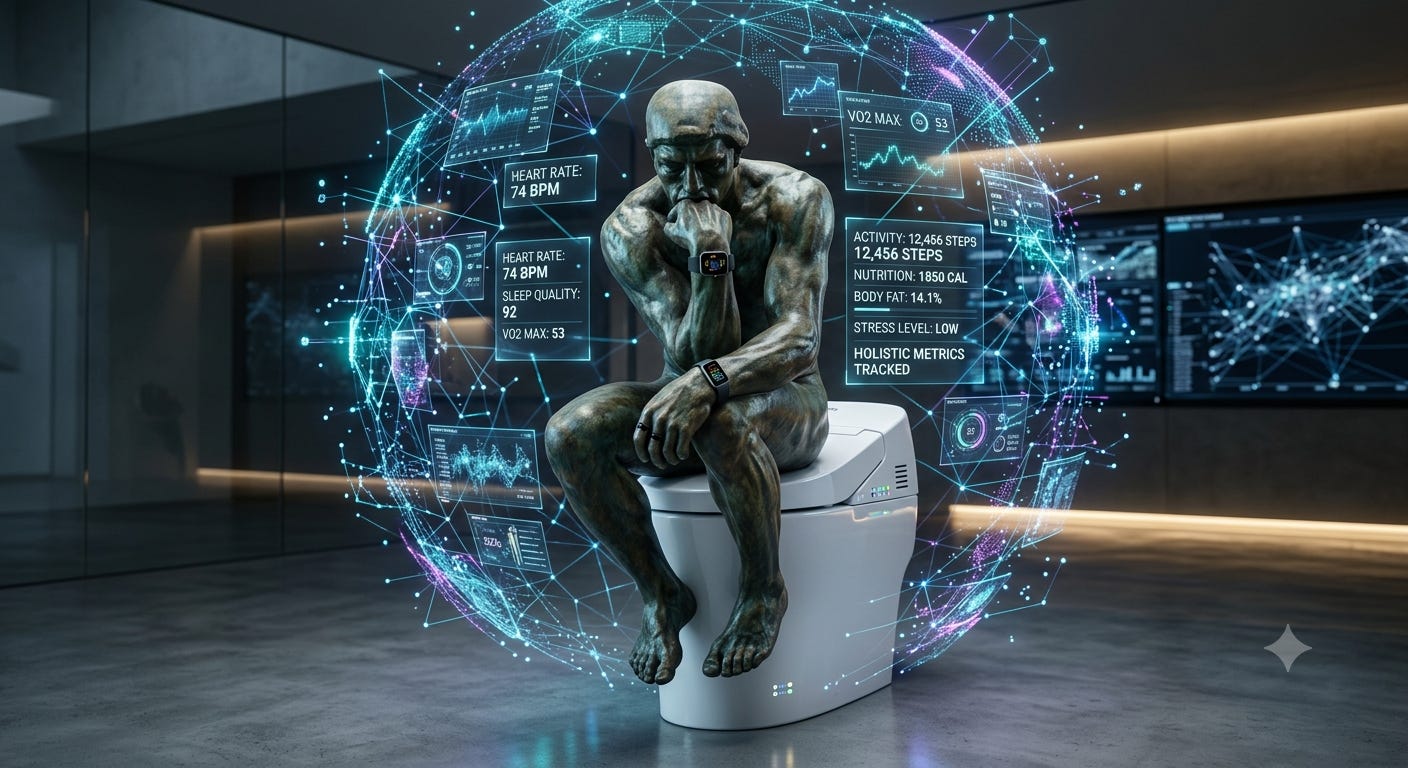
It seems that every longevity protocol coming to market looks similar: episodic biology, quarterly bloods, annual scans, a wrist wearable - and little in between. The daily-data layer they’re missing is in the bathroom, and no one has yet built the operating system to read it.
A device you can’t take off
The late Sanjiv Sam Gambhir of Stanford, who built the first precision-health toilet, used to say: you can’t take the toilet off. The wrist comes off, the patch peels, the ring goes in the drawer; the toilet remains where it is, used 6 to 8 times a day by everyone. Age, income, motivation or digital literacy don’t come into it. As such, the biggest story in health infrastructure may be what few think of as infrastructure.
The flagship private clubs and precision-health operators don’t mention toilet data: Human Longevity, Atria, Biograph, Continuum, EQX, Fountain Life, Clinique, Hone, Sollis globally (the list is fast growing), or Saint Haven and Everlab here in Australia. They charge between US$500 and US$100,000+ a year for an episodic stack. Between visits, members return to a data vacuum of 90 to 365 days, while the bathroom sits unused.
The wearables’ Achilles’ Heel: they’re worn by the healthy
The wearable category has a problem: roughly one in three stop wearing them within six months. And the cohorts that wear them through 12 months are healthier and wealthier than the cohorts that don’t; results are contaminated by selection effects. The people who would benefit most- older adults, the early-chronic-disease cohort, the digitally less-engaged - have the lowest adherence.
The bathroom flips that. The fixture is the device, not the behaviour; there is no adherence curve to decay, and no cohort the device can’t reach. It also reaches biological signal the wrist cannot:
Urine chemistry. Albumin-to-creatinine ratio, creatinine excretion (a validated muscle-mass proxy and mortality predictor), oxidative-stress F2-isoprostanes, hydration, electrolytes. No wrist-based sensor touches this.
Stool form and transit. Bristol scale via in-bowl camera, bowel-movement frequency, occult blood. Slow bowel-movements are linked to cognitive aging, and gut distress is a known side effect of GLP1s.
Seat cardiovascular. ECG and PPG from contact with the seat (Casana’s Heart Seat received FDA clearance in 2023), with ballistocardiographic stroke volume and emerging cuffless blood pressure measurable on the same surface.
Gait and balance. Falls often happen in the bathroom, and measurable gait speed is predictive of frailty.
Voiding chronobiology. Nocturia (2+ nighttime voids) carries a 1.78× all-cause mortality hazard - this signal requires nothing but a timestamp.
Five biomarker classes here (there are others); wearables don’t get these.
The episodic-data problem the wearable was meant to fix (and didn’t)
Peter Attia suggests treating glucose, sleep and movement as continuous variables rather than annual datapoints. It seems the same holds for urine, stool, voiding patterns and heart and blood flow data.
Clinical longevity: more money than data
It seems that a US$40,000-a-year member of an EQX Optimize stack (you can pick any pricey membership) is generating, on average, fewer than one datapoint per blood biomarker per month. An instructive failure here is Forward Health, which raised roughly US$400 million on the thesis that primary care could be automated through in-store CarePod kiosks, and collapsed in November 2024. The CarePod still required a behaviour, namely that members leave home and visit the kiosk.
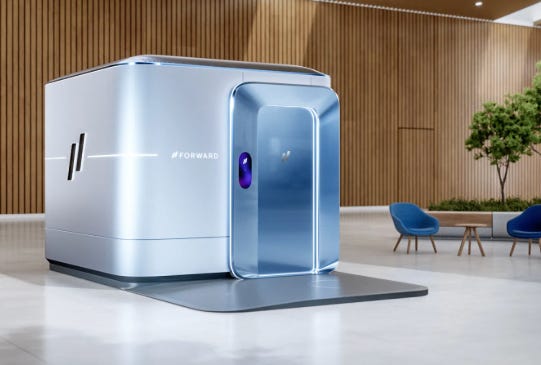
The bathroom inverts that failure mode. Missions make markets, and the mission here is the conversion of episodic biology into continuous biology with no behaviour to change.
Building the bathroom health operating system
The hardware already exists, and new tech is emerging daily. Stanford, Toi Labs, Casana, Withings, ZIBRIO and the major OEM / fixture players have each built parts of the puzzle. None occupy the integration layer that would make them a system.
The market potential, if done right, is huge. One research report suggests the smart toilet market (not a broader smart bathroom play) sits at around US$160 million today, with a CAGR of 54%, to get to US$3.2 billion by 2032.
A handful of us have started building and are now having conversations with relevant stakeholders to discuss what would it take to make this happen. At a simple level, we think building the bathroom OS requires overcoming three difficult, but not impossible, challenges: Proof, Privacy and Platform.
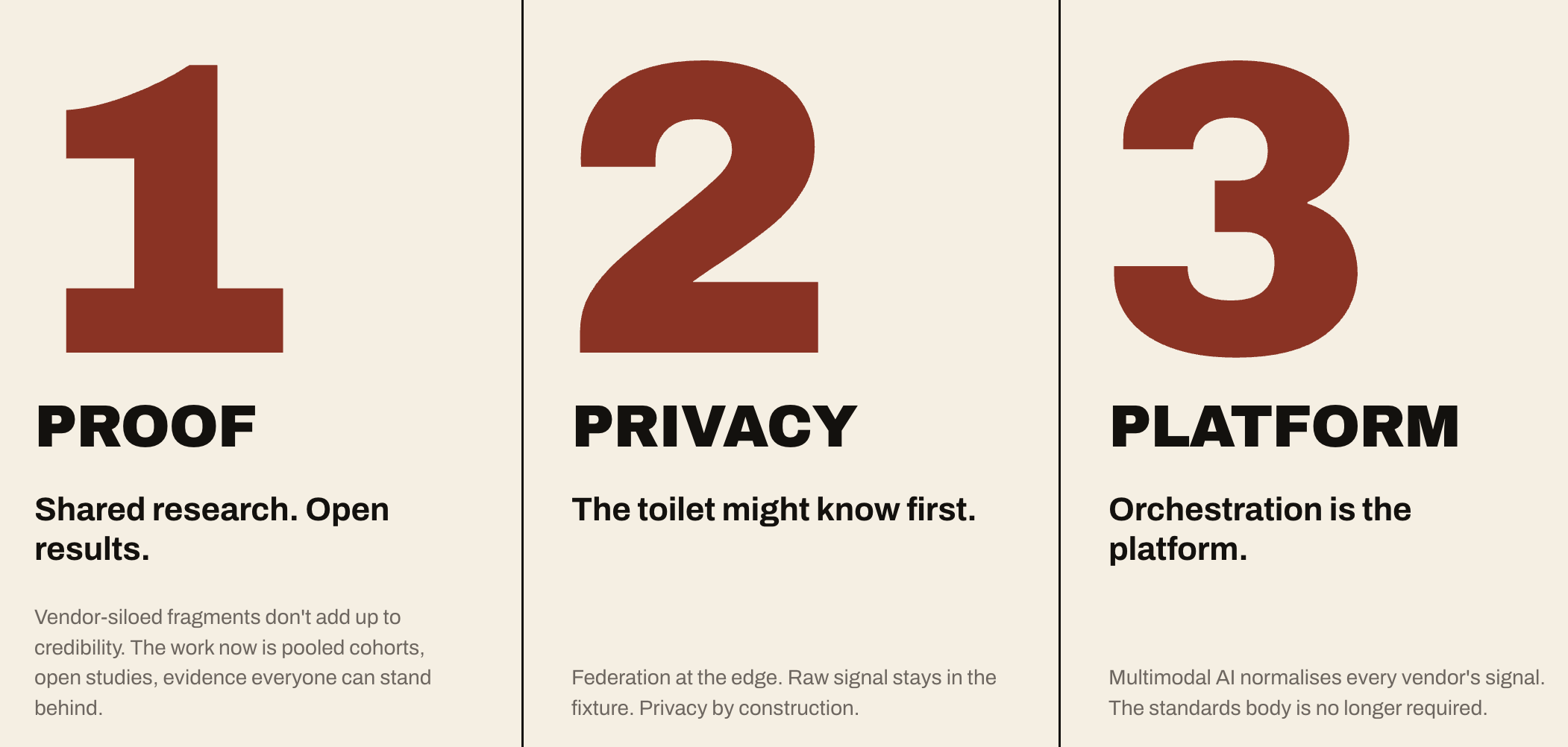
1. Proof
The science is real, though unevenly distributed. The Stanford team (Gambhir, then Park) built the first precision-health seat with uroflowmetry, a ten-marker urine dipstick, a stool CNN and analprint identification, published in a 2020 Nature Biomedical Engineering paper. Toi Labs’ TrueLoo has published accuracy evidence, Casana’s Heart Seat has been cleared by FDA, Withings’ U-Scan is already shipping in the US and EU. TOTO began shipping the Neorest Stool Scan in Japan in August 2025, and last autumn’s HLTH conference saw Kohler announce their Dekoda device, while Throne Science is making a similar device, with a Whoop co-founder as one of the key employees.
The regulatory pathway that keeps this buildable without becoming a medical-device licensing problem is the wellness route: frame the output as lifestyle monitoring rather than diagnosis, stay under the FDA safe-harbour provisions, and route clinical interpretation through the operator – a licensed physician or longevity practitioner – rather than through the device.
The most valuable signals, in my view, are not the ones the toilet or the wearable produces alone; they emerge when both data streams work together. Therapeutic adherence - a multi-billion dollar problem - is one example. The drugs now prescribed for chronic metabolic conditions produce downstream changes in gut output, transit time and voiding pattern that a bathroom fixture captures continuously. Add a wearable’s activity and physiological response, gut microbiome sequencing underneath, or new sensor modalities, and you get something interesting: real-time adherence mapped to individual’s physiological response.
The advantage today is architectural (zero adherence decay, new biomarker classes) and mathematical (more longitudinal data accumulates by construction), but not yet demonstrated in outcome data. A natural next step here is a living-lab partnership with one or more of these operators, and be the first to build a genuinely deep longevity stack that does a better job of prediction and prevention.
2. Privacy
Over the past few months I’ve been speaking with experts from the worlds of tech, design and business. Privacy comes up in every conversation. Nobody doubts the boundless capabilities of tech, and that’s the problem.
Emma Caselton emphasised the bathroom as not just another health-data surface, but a private, sensory, escape – the one room in the house that is reliably yours. A smart toilet that turns the room into a surveillance scanner could do untold damage. The fear is not only data collection. It is unwanted revelation: “That toilet could find something”. This was echoed by Sarah Gold whose work on data trusts and consent design has shaped privacy policy in the UK and beyond. “The toilet might know first.” If a monitoring system detects a urinary tract infection before the user is aware of it, how does it communicate that in a way that’s supportive not an ambush?
Matt Webb, a leader in ambient computing in domestic space, identifies a subtler harm: the feeling of being watched, before any misuse occurs. “I think we are insufficiently aware of how much continuous monitoring causes a kind of sense of being watched, or paranoia.” He also adds a final caution worth heeding: “I think otherwise it will pattern-match very quickly into something which is just a Fitbit but on the toilet.” Is Fitbit for the toilet actually a bad thing? Discuss!
The architecture that resolves this is probably federated: raw signal stays in the fixture, the individual or household holds the rights, only derived outputs cross the boundary. Privacy-by-construction, not privacy-by-policy. New AI and privacy regulations are driving in this direction.
3. Platform
No one has built the integration layer yet - these things are hard and historically required a formal standards body, which are slow, by design.
Generative AI has, over the past two years, shown that semantic interoperability no longer requires a committee. A multimodal model running at the edge can read a uroflow trace, a Withings urine cartridge readout, a Casana ECG and a ZIBRIO gait signature, and normalise them into the same household longitudinal record - without any of the vendors having agreed on a shared taxonomy first. This coordination superpower is one that Sangeet Choudary has argued for as a ‘permissionless ecosystem’. New platforms (like UK AI insurtech Tractable) are not built on agreed standards, but shared value. Stakeholders get more out than they put in, so happily share their data.
Applied here, the bathroom OS does not need every vendor to agree on a data schema; it needs a good-enough semantic layer and a value proposition strong enough that organizations participate because not participating costs more than joining.
The hardware is not the platform; the orchestration is. The household is both producer and consumer of the signal. Choudary has never named the bathroom in his books, as it’s not been an obvious place for this to live. So far.
The missing node of the hospital-at-home is the toilet
Eric Topol has been making the hospital-at-home argument for a decade. The room he does not name is the bathroom. Andrew Huberman’s five pillars (sleep, nutrition, exercise, light, stress) are all measurable through the bathroom. David Sinclair frames aging as an epigenetic information problem; the bathroom is the daily readout instrument. Tim Spector’s ZOE requires members to mail in a stool kit; the bathroom is the continuous-capture answer to the signal his cohort is built on.
Bryan Johnson is the most measured human alive, and though he loves over-sharing (the high quality of his girlfriend’s vaginal microbiome, as just one example), I’ve yet to see his toilet talk.
It seems that, initially at least, a smart toilet won’t be about detecting disease (regulatory and evidence burden is very high); it’ll be the lowest-friction continuous-data infrastructure in healthcare. It will be the missing daily layer under longevity stacks, and the first node of the hospital-at-home for the household that has not yet been wired.
If we get our way, BHOS will make this happen: as a platform that standardises the data layer across the hardware vendors already shipping, as a consumer data trust that safeguards individual data, and as capital to finance the integration into validated solutions that need to scale.
____
As always, feedback and pushback welcome, particularly from operators already running deep diagnostic stacks who would like to extend them into the bathroom, and from designers, consent practitioners and technologists working on the trust architecture that this whole idea will be built on.